Travel

TELLURIDE 2014

dogs of Telluride 2

The Dogs of Telluride

The Telluride Film Festival’s nabobs may have gotten the word. After recent years of bad scheduling (wildly popular films in small venues) and general overcrowding, they have done better: improved (but still far from satisfactory) scheduling; a good iPhone app; morning email notifications of sneak previews and TBAs (repeats of crowd pleasers); and a redone opening feast, with better seating and multiple serving points.

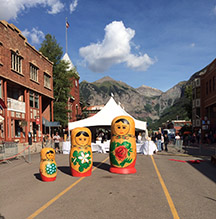
This year’s opening feast on Colorado Avenue brought crystalline Telluride weather together with an outstanding Russian-Ukrainian themed meal: roast salmon and lamb, tiny cups of borscht, nutty tea cakes for dessert. Russia and Ukraine may be at one another’s throats but not on Telluride’s high street.
feed

If the feast was an auspicious beginning, our opening film at the beautiful new Werner Herzog Theater (650 seats) was overwhelming. The Imitation Game, starring Benedict Cumberbatch and Keira Knightly, and under the direction of the veteran Norwegian director Morten Tyldum, chronicles the life of Alan Turing, the semi-autistic, homosexual mathematician and computer pioneer who led the team of British geniuses at Bletchley Park that cracked the German Enigma codes and arguably saved millions of allied lives during WWII.

A constant refrain in the film, uttered by friends and colleagues at each moment in Turing’s life when he faced terrible obstacles is: “The people you can’t imagine anything of are the very people who create what you can’t imagine.”

Benjamin Cumberbatch, in what will certainly be an Oscar-nominated performance, shows us the many sides of Turing, who was drawn to code breaking because for him the simplest human communication—”Want a sandwich?”—was a code to be cracked.

What is astonishing about The Imitation Game and Turing’s story are its lessons for today. We see the toll taken on Turing’s life—and at times the British war effort—by homophobia, bullying, and sex discrimination. At one point the brilliant mathematician played by Keira Knightly is almost consigned to the secretarial pool.

Tyldum’s direction (and an excellent screenplay by Graham Moore) bring everything together: a moving personal narrative, a touching love story as Knightly’s character and Turing reach out to one another; and an exciting WWII period peace, with a top ensemble of British actors.

Above all The Imitation Game shows how important it is to nurture the abilities of every human being, including those of whom “you can’t imagine anything.”

I hope The Imitation Game makes it to the Cineplex and the Oscars. Don’t miss it.

RON’S GRADE: A

Saturday morning began for me (as my wife and sister went elsewhere) with The Decent One, Vanessa Lapa’s documentary account of the life of Heinrich Himmler. Introducing the film and Lapa, the grandchild of Holocaust survivors, the theater’s host remarked, “If you’re here to see this film you’re either a World War II cinephile or Jewish.” I guess I qualify on both counts, and for me this was the fascination of the film. Having recently read Peter Longerich’s Heinrich Himmler: A Life I was amazed by the collection of still photos and films that director Lapa was able to gather. Here is Himmler dandling his infant daughter Gudrun on his lap. Here he is bringing Gudrun and his wife, Marga, Christmas presents during the war; and here, just days before, he is walking through an inspection tour of Auschwitz at the height of the killings.

By juxtaposing readings of warm and intimate family correspondence with the photographic record of Nazi brutality, The Decent One reinvigorates Hannah Arendt’s point about “the banality of evil.” On a slightly critical note, while I understand that the film is an Israeli-Austrian-German co-production, and though I understood much of the German, I wish the filmmaker had chosen to prepare an English language version of all the readings and voice over material. The visual images are so new and so interesting that it was painful to have to take my eyes off them to read the English subtitles.

One troubling and sad note. Throughout the film we watch Gudrun’s growth from infancy to adolescence. Of course, one can understand how a child can love her father, even if in his professional life he’s a monster like Himmler. But it was disturbing to learn at the close that Gudrun is alive and a major figure in an organization that supports surviving Nazi war criminals and other neo-Nazi activities. How fortunate she is that the victorious allies did not believe in her father’s practice of Sippenhaft, the execution of the families of his opponents.

RON’S GRADE: B+

After being turned away from our chosen afternoon film, Rosewater (yes, scheduling problems persist), we changed course and headed to Madame Bovary. An early arrival gave us the opportunity of talking at length with a fascinating pair of physicians from the Bay area (she Canadian; he a Canadian immigrant from India) for whom this was their first Telluride. They were enchanted with the Festival, and we enjoyed learning about their medical-business doings in that effervescent part of the country. Line time at Telluride is never wasted!

Have you ever traveled somewhere and found, strangely, that your best memories are from that unexpected and not immediately important moment: the quick picnic lunch on a hillside; the crowded train compartment with engaging fellow travelers?

Madame Bovary is like that. Despite being a bit slow and not in every respect emotionally convincing, the film by the young French director Sophie Barthe sticks with you. You find your thoughts going back to the village of Yonville in mid-nineteenth Normandy, where Emma Bovary, beautifully played by Mia Wasikowska, is a newly married young woman at once intoxicated by her readings in romantic literature and suffocated by provincial life and her dull physician husband, Charles. Cinematographer Andrij Parekh brings you into the life of this gray/green village, where well watered fields and forests lie under a sun that almost never seems to break through. We watch Emma as she pushes the unwitting Charles into insurmountable debt and as she careens from one brief love affair to another in the effort to fill the void at the center of her heart. The exquisite dresses on which Emma spends Charles still unearned earnings vividly illustrate her dreams of beauty, wealth, and status. Emma’s tormented suicide, with which the film both begins and ends, is inevitable.

On a critical note Henry Lloyd-Hughes may be miscast as Charles Bovary. Whereas Charles in the novel is an unattractive boor, Lloyd-Hughes is both handsome and devoted, making it emotionally hard to understand Emma’s discontent. We wonder why she undertakes her destructive trajectory.

RON’S GRADE: A minus

Saturday began early for us, with a 7:00 AM gondola ride up the mountain for what we expected would be a wildly popular tribute to Hilary Swank and viewing of her latest film, The Homesman. Our prudence was well rewarded. Although hundreds turned out for this event, we secured seats near the stage. Despite her frequent playing of roles as an unattractive woman, Swank is vivacious and she offered fresh answers to the interviewer’s questions about her ascent from trailer park childhood to Oscar-winning stardom. Never professionally trained, she learned acting by obsessively watching other people (as a child her mother repeatedly told her, “Stop staring!”). Even today, she eschews the separate world of Hollywood superstars and rides the L.A. metro in order to watch and learn from her fellow passengers.

HS 1 HS 3

Based on the novel by Glendon Swarthout, directed by Tommy Lee Jones and starring Jones and Hilary Swank, the Homesman celebrates the classical Western genre, but in a new mode. Mary Bee Cuddy (Swank) is a thirty-one year old spinster efficiently managing her own small farm in the far Western territories. Three local woman, faced with the terrible stresses of frontier existence, including one’s loss by disease of all her children in a single day, have gone mad. At least one of them is violent and needs restraint. The women must be taken back east to civilization, but none of the handful of local men can leave their families, so Mary Bee volunteers. As her solitary journey riding a wagon with the women locked inside is about to begin, Mary Bee encounters George Briggs (Jones) in dire straits and persuades/coerces him to accompany her. What follows is a journey of spiritual redemption, but one not without its reverses and non-Hollywood turns. Never have the landscapes of the plains West been more beautifully filmed than they are here by Oscar-nominated Rodrigo Prieto. Jones as Griggs and Swank as Mary Bee (“as plain as tin pail”) offer outstanding performances. The Homesman is somewhat marred in its plot and direction by a measure of Jones’ self-promotion. These blemishes may prevent The Homesman from being a Hollywood smash, but, nevertheless, it is a Western that at times reaches the heights of both versions of True Grit, and The Unforgiven.

RON’S GRADE: A minus

I’m beginning to think that this year’s Festival has a theme. It’s “redemption and perdition.” Clearly, Madame Bovary and the Himmler documentary fit into the second category. The Homesman is profoundly about the first, as was our afternoon film, Two Days, One Night, the latest gritty realist film about lower-middle class life in today’s Belgium from the amazing Dardenne brothers, Jean-Pierre and Luc. The background is growing unemployment in a small Belgium city. Sandra, courageously played in this small film by Marion Cotillard after her triumphs in La Vie an Rose and Rust and Bone, has been laid off at a small solar panel manufacturing firm as a result of Asian competition. Management has agreed that she can keep her job if the majority of her sixteen fellow workers each forego their pending one thousand euro annual bonuses. Sandra and her husband Manu (sensitively played by Fabrizio Rongione) have a weekend to convince nine of her colleagues to vote for her. Each encounter is a lesson in either human selfishness or human compassion. Running beneath this effort is Sandra’s depression from which she is only recently recovered and which contributed to her being laid off. The threat that unemployment and social dependency represent to Sandra’s sense of self worth and the judgments of her peers reveal themselves as even more important than her loss of salary. The film gives new social meaning to the themes of perdition and redemption. Two Days, One Night will predictably not make it into a single Cineplex. But is the kind of film for which one comes to Telluride.

RON’S GRADE: A

Can a mother’s love save a developmentally scarred child? This is the question that rings through the final film of our day, Quebec director Xavier Dolan’s, Mommy. We first meet Diane (Anne Dorval) in a juvenile detention facility where she is picking up her teenage son Steve (Antoine Olivier Pilon). Steve is responsible for a fire that badly injured another boy at the center, but Diane, a sexy, middle-aged working class woman who seems to be propositioned by every man she meets, is not yet ready to invoke a new Canadian law that will allow her to commit Steve to prolonged incarceration. What follows is a roller coaster ride as Steve careens between charming youthful exuberance and deadly violence against Diane, himself, and others. Neighbor Kyla, a high school teacher who is unable to keep her job because of a nervous speech impediment (whose cause is only cryptically suggested) enters their lives, bringing friendship and fun to Diane and Steve, as well as assistance with home schooling that may help fulfill the mother’s and son’s dream of high school graduation and a Juilliard admission for Steve.

I’ll say no more about Mommy’s plot, since anything further would be a spoiler. Mommy shared the Grand Jury Prize at Cannes this year with the renowned director Jean-Luc Godard. As a film, however, Mommy disappointed me. Steve is so wildly extreme in his behaviors and moods that we never quite learn to love or hate him, and we remain emotionally perplexed by Diane’s (and to an extent Kyla’s) devotion to him. Mommy is a glimpse into the tormented world of a parent with a disabled child, but it is one we are glad to leave.

RON’S GRADE: B

Labor day, the final day of the Festival, began for us with Dancing Arabs, a film adaptation directed by the Israeli director Eran Riklis (The Syrian Bride, The Lemon Tree) of two largely autobiographical novels by Sayed Kashua, a popular Arab-Israeli Haaretz columnist and writer of an award-winning Israeli television comedy series. We meet Eyad (very well played in his teenage years by Tawfeek Barhom) as a child growing up in a close Arab-Israeli family and neighborhood. Intellectually gifted—Eyad alone is able to crack a TV puzzler—he dwells in a milieu boiling with Palestinian nationalist sentiments (later we see his family on their roof cheering Saddam Hussein’s missile attacks on Tel Aviv). But then Eyad is accepted as the sole Arab at a prestigious Israeli boarding school in Jerusalem. What follows is a coming-of-age saga. Eyad, excels at school, begins a sweet love affair with Naomi, a beautiful Israeli girl, and as part of the school’s community service outreach, befriends Jonathan, a wheelchair-bound and homeschooled classmate suffering from muscular dystrophy. We watch Eyad practicing his pronunciation in an effort to eliminate his Arab accent. As he gains confidence and a measure of recognition from classmates, Eyad offers his literature class a penetrating critique of the stereotypical and sexualized depiction of Arab males in many esteemed Israeli novels. But Eyad’s effort to dwell simultaneously in the opposing Arab-Israeli and Jewish-Israeli worlds founders, and in the end, Eyad is forced to find his own difficult way out of the conflict.

Dancing Arabs is neither pro-Palestinian nor pro-Israeli. It holds out the hope that if these two peoples could get to know one another better, they might see themselves as the siblings that they are. The film’s premier in Israel on the eve of the recent Gaza conflict was postponed, but it was finally shown in a limited venue to strong audience approval. Dancing Arabs will almost certainly not be shown in any commercial movie theaters in the U.S., outside of a screen or two in New York, but it is one of the reasons we come to Telluride.

RON’S GRADE: A

Our Festival ended—and culminated—with Rosewater, the first feature film written and directed by Jon Stewart, comedian host of The Daily Show.

But I must note first that Rosewater was preceded by a vivid eight-minute French short subject, Aïssa (directed by Clément Tréhin-Lalanne). A pretty Congolese teen’s physical exam will determine her destiny. Is she older than eighteen, in which case she’ll be deported from France, or is she younger and able to stay and pursue her intended career as a cosmetologist? As Aïssa undergoes a rigorous and invasive physical exam, we hear her unseen medical examiner record his notes. Conclusion? The bone structure in Aïssa’s hands indicates an age of perhaps twenty, “although all our ossification graphs derive from Caucasians and we have none for Africans.” Probed and measured against possibly irrelevant standards, Aïssa will certainly be deported.

Rosewater is adapted from a memoire by Maziar Bahari that records his months of imprisonment at the hands of Iranian state authorities. During a journalistic visit to Teheran, Bahari, a young reporter for Newsweek (and well played by the Mexican actor Gael García Bernal), happens to film the murderous repression of a street demonstration against Iran’s deeply flawed 2009 presidential election. He is soon arrested and subject to months of solitary confinement, only interrupted by intimidating interrogations and occasional violence at the hands of a “specialist.” During his incarceration, Bahari is sustained by frequent “conversations” in his cell with his deceased father, who, as a Communist had been imprisoned and tortured under the hated previous regime of Shah Palavi. In various ways, Bahari eventually learns to outwit his captors. The film ends on a happier note but not without revealing the generations of lawless authoritarianism and terror to which the citizens of Iran have been subject.

RON’s GRADE: A minus

This was not our quantitatively most intense Telluride. Over three days, we managed to see only eight films (as opposed to my all-time record of sixteen). But if low on quantity, this year’s festival was high on quality. We saw several films that will not likely be screened elsewhere, and even the worst of the films (Mommy?) stimulates continued thought. Strolling late in the day in the light of a Telluride sunset, we look forward to next year.

Telluride at Sunset

Standard
Travel

Around the World by Private Jet

AROUND THE WORLD BY PRIVATE JET

WITH DARTMOUTH ALUMNI TRAVEL

AND TCS & STARQUEST EXPEDITIONS*

OCT. 29 TO NOV 19, 2013

I have been an enthusiastic traveler since my childhood, when I first read  Richard Halliburton’s wonderful Complete Book of Marvels, with its pictures of the author swimming in the Panama canal.

On Oct. 30, I take off for a three-week trip as an academic lecturer on a trip by private jet around the world. This trip is open to alumni from Dartmouth, Princeton, University of Virginia and other colleges, universities, and programs. I will be serving as one of three guest lecturers on the trip. The others are Alan Mann of Princeton and Fred Diehl of University of Virginia.

Our destinations include: Machu Picchu, Easter Island, Western Samoa, Australia’s Great Barrier Reef, Angkor Wat, Jaipur-Agra (and the Taj Mahal), the Serengeti (and Ngorongoro Crater), Petra (Jordan), and Fez, Morocco. I will be delivering five lectures in the aisle of the jet.

What follows is my account of this trip. Please note that in order to get the posts in reverse chronological order, I have had to place erroneous dates in the left hand column. The heading dates are the correct ones for each entry. You can expand smaller pictures by clicking on them.

* For more on TCS & Starquest, see http://www.youtube.com/watch?v=lzdsJTjSgsg

Standard
Travel

DAY 1, WED., OCT 30, MORNING: This first post is being started as we make landfall on the South American continent (about 35 thousand feet above the what looks like the desiccated Colombian coast). On this first full day, I and my 88 fellow travelers (about 80 “guests” and the rest of us “staff”) are on our way to Lima, Peru, and from there by air to Cusco and train to Machu Picchu. The descriptive words that come to mind so far are “convivial” and “deluxe.” The guests are middle aged or older, come from every part of the nation, and are avid travelers. Most are well to do, but at least some appear to have “saved up” for this once in a lifetime trip. As I found from the reception last night and today’s trip to the airport, they’re eager to talk and learn about the lecturers’ fields and backgrounds. My faculty colleague Alan Mann (a Princeton anthropologist) just delivered his first lecture in the aisle of the airplane (on Inka civilization) and it met with enthusiastic applause. The food, beverages, and service are exceptional. Iceland Air provides the plane and crew, so lunch today was preceded by a glass of amazingly smooth Reyka, triple distilled vodka. What to say? This is not Southwest’s peanuts and Coke.

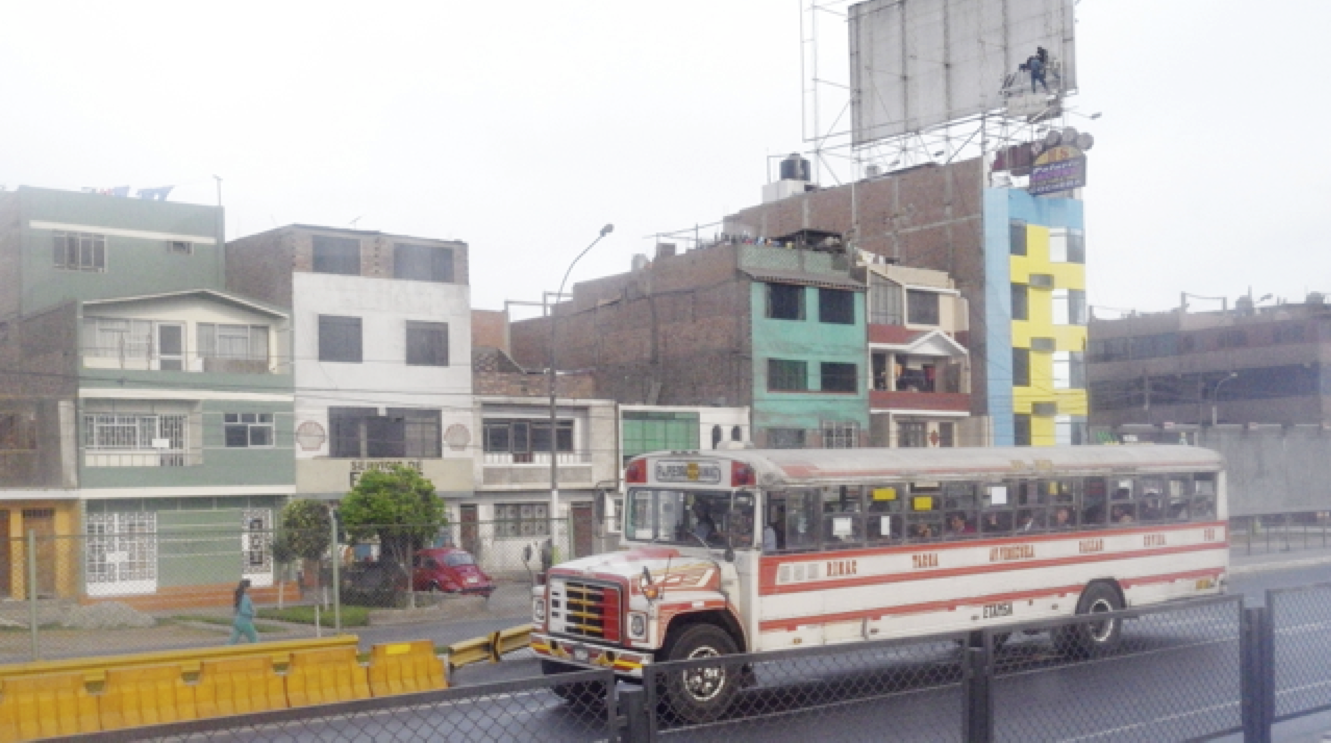
AFTERNOON AND EVENING: We had a great day today, arriving about 2:30 PM in Lima and going directly by bus to the Peruvian (Rafael Larco) ethnographic museum. The Lima we passed through is a diverse city with many poorer barrios. Right near the airport, a plywood favela community was going up in flames in a terrible conflagration as we passed by.

rmgphoto1

But I would not say that the city appears desperately poor. Most of the neighborhoods are tidy and filled with modest and well-kept homes.

rmgphoto2

There are numerous well-tended parks, some dotted with doggie statues reminding owners to clean up after their pets. The neighborhood of our hotel, Miraflores, could easily be mistaken for seaside Miami or Rio de Janeiro.

rmgphoto3

The afternoon ended at the Rafael Larcos museum and its collection of magnificent pre-Inkan jewelry, pottery, and fabrics. Accompanying is a picture of one of the most breathtaking of the museum pieces: a beautiful pre-Inka gold and turquoise necklace.

rmgphoto4

The day came to a close for me after dinner with a viewing on the Spanish sports channel with the last inning of the Red Sox-Cardinals game, and the Sox’s World Series victory. I’m no sports fan, but I was really pleased to see Boston, which has suffered so terribly this past year, get this much needed moment of triumph. Up at 5:30 tomorrow for our flight to Cusco.

THURSDAY, OCT. 31

Our early morning drive to the airport confirmed my impression of Lima, now with a population of nine million in a country of thirty million, as a city coping well with the vast influx of rural immigrants. The streets were streaming with kids and parents in football outfits on their way to all sorts of schools, from elementary schools to colleges and universities (many with a strong Catholic presence), See the accompanying photo of one very typical mother and daughter.

rmgphoto5

Urbanization can create the impression of chaos, but cities are often the sites where modernization and upward mobility takes place. Lima seems a textbook case.

DAY 2, THURS., OCT 31:

After getting settled at the beautiful Palacio Nazarenas hotel in Cusco (disturbed only by a slight headache from the 11,300 foot altitude), we began  a tour of Cusco’s main plaza and grand Cathedral.

rmgphoto6

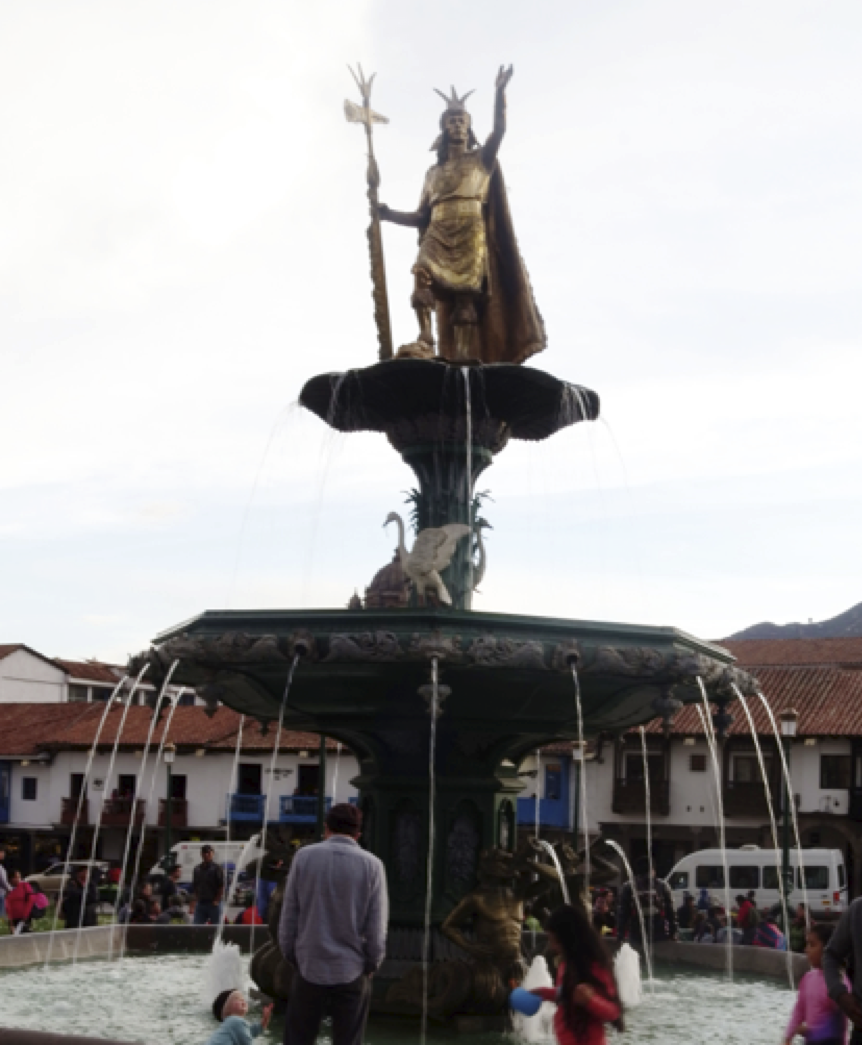
This plaza was once the heart of the Inka Empire, and surrounded by Inka buildings (today a beautiful statue and fountain of an Inkan emperor stands at its center).

rmgphoto7

After 1530, the Spanish conquerors began replacing all of these Inkan buildings with Christian ones, often built of stones from the destroyed Inka edifices. The great Cathedral (it has no special name) dominates the plaza. It’s interior (photographs not permitted), filled with paintings, cedar carvings, and gold leaf decoration is magnificent. One of the most colorful and ornate Christian buildings I have ever seen. On the main altar today is a life-sized statue of Christ crucified made of wood and covered with leather blackened by centuries of candle smoke. But Christ is only a temporary resident: there for a week of celebration during which he is paraded through the streets until he is installed for a brief time in front of a permanent sculpture of Mary above the altar. Among the paintings: a depiction of the last supper with the central dish a roasted “cuye,” a guinea pig and a specialty of Peruvian (and Inka) cuisine. Was the native artist just ignorant of the fact that Christ the Jew would never eat a rodent? Or was this a subtle dig at the Spanish invaders?

This theme of indigenous Peruvian resistance against the Spanish (declared on a recent building wall graffito) was often repeated by our guides’ descriptions. Our guide, Dagmar (despite her name a thoroughly Peruvian woman) told us how Peruvians to this day, bring offerings to the Virgin that are just like those that their ancient ancestors brought to Pachamama, the earth goddess. “We are ‘Católicos,’ she said, but ‘syncretistic Católicos.”

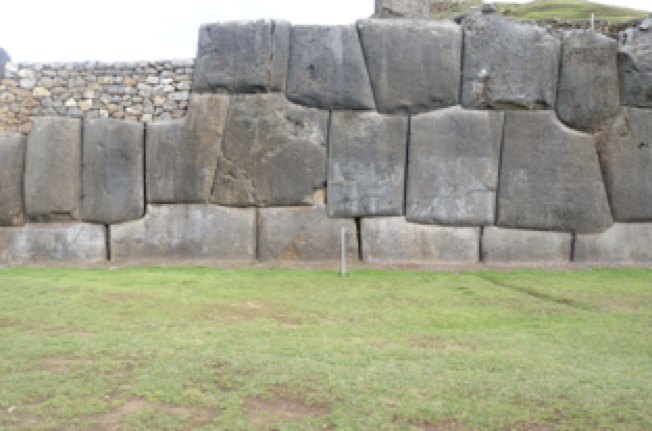
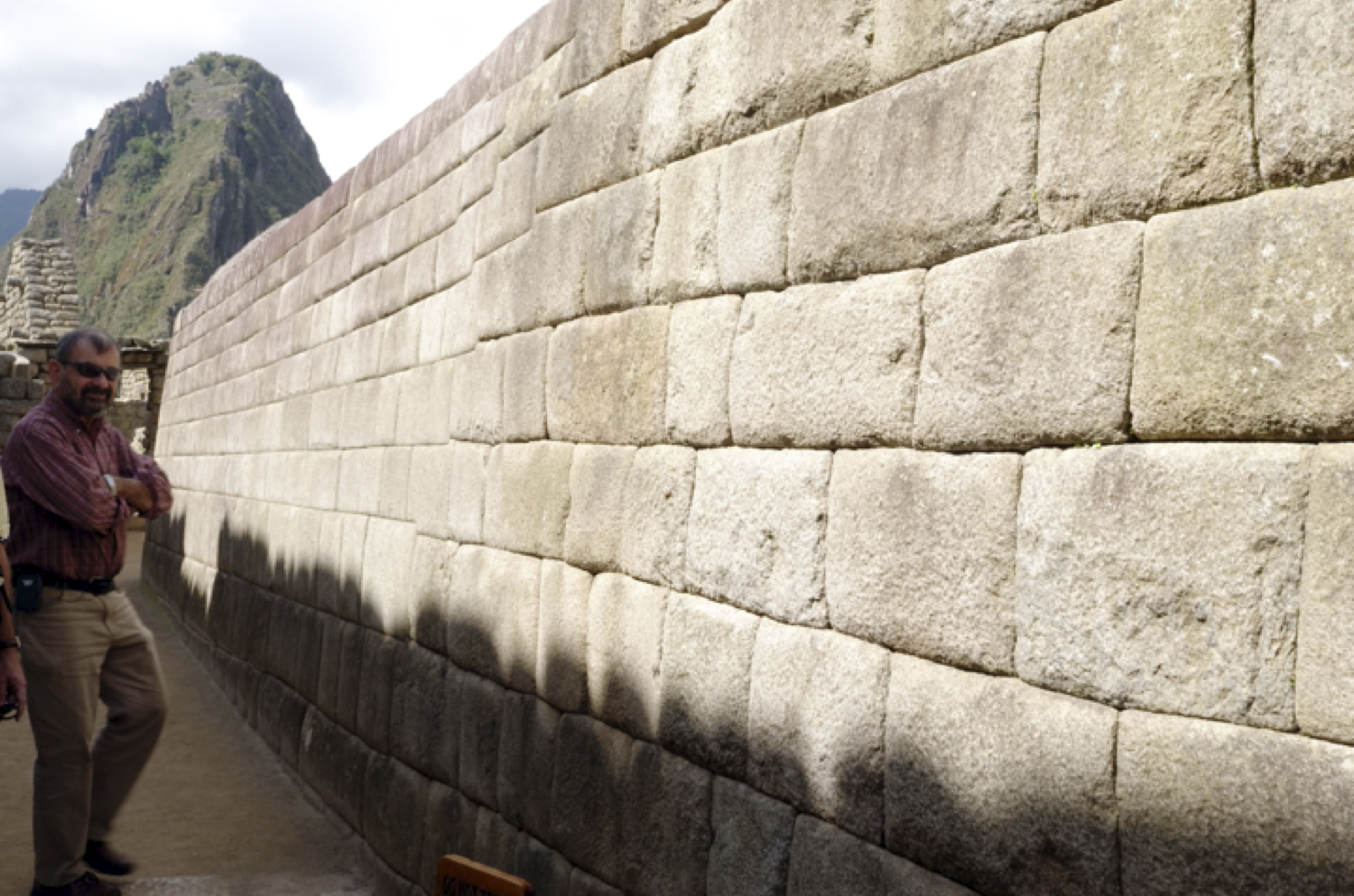
After a buffet lunch at the hotel, we journeyed a thousand feet up a mountainside to a vast field where the Saqsaywaman (“Sexywoman” is offered as a mnemonic device) stands. This is a mammoth layout of Inka temple sites that served as the ritual center of the empire. We walked a kilometer across the fields, awed by the amazing stone architecture in which limestone blocks weighing ten tons are fitted together so precisely that not even a piece of paper can pass through the joints. A special feature of Inka architecture, seen and mentioned again and again over these two days, is the use of interlocking and dovetailed blocks of stone (giant Legos?), designed to resist shifting during the devastating earthquakes that occur here roughly once a century. The Inka sites (including Machu Picchu) have all survived, while later Spanish architecture has frequently been destroyed.

rmgphoto8 rmgphoto9

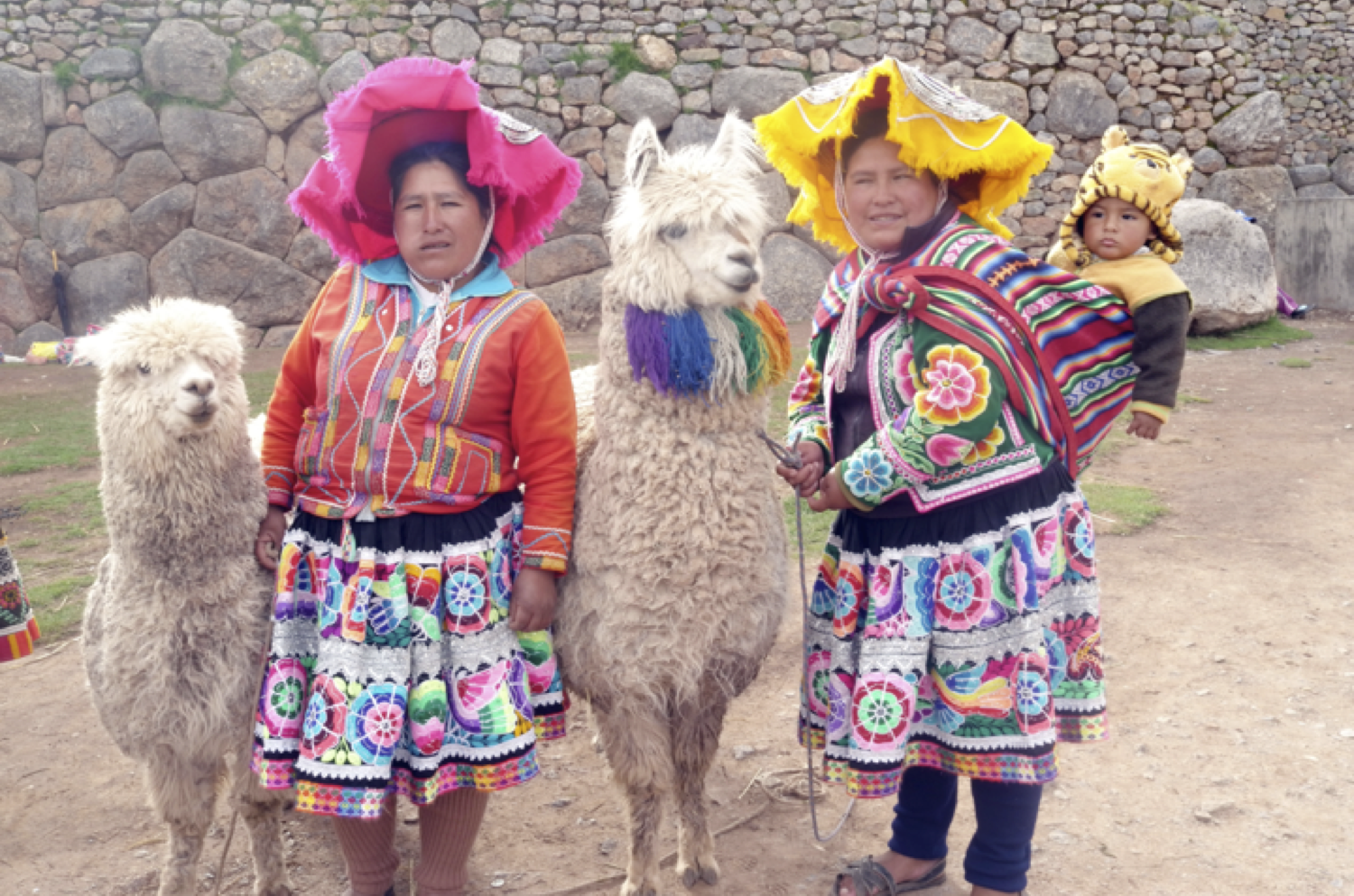
Following Saqsaywaman, and a brief encounter with a group of indigenous women and their “families”

rmgphoto10

we returned to the city for a visit to Korikancha. This is now a Franciscan monastery, but at its interior are the preserved “houses” and walls of what was once a large Inkan temple compound. Again we were astonished by the precision of the stone edifices. A model illustrated the fact that the whole compound was once surrounded by a protective wall, on the top of which was gold leaf to indicate the compound’s sacred contents. The Spaniards took three months to strip that gold away, melt it down to bullion, and ship it back home, as they did with all the Inka gold and artifacts they found.

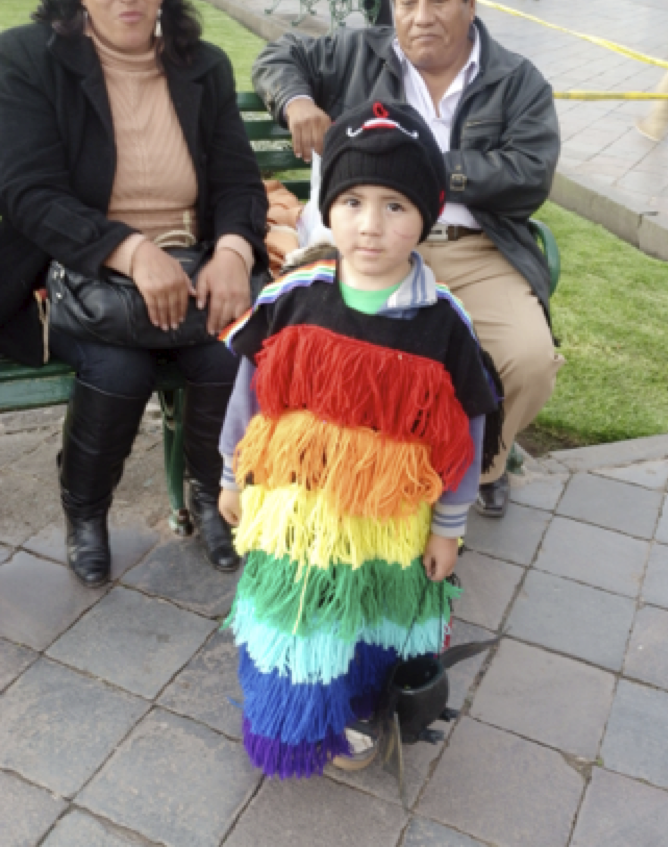
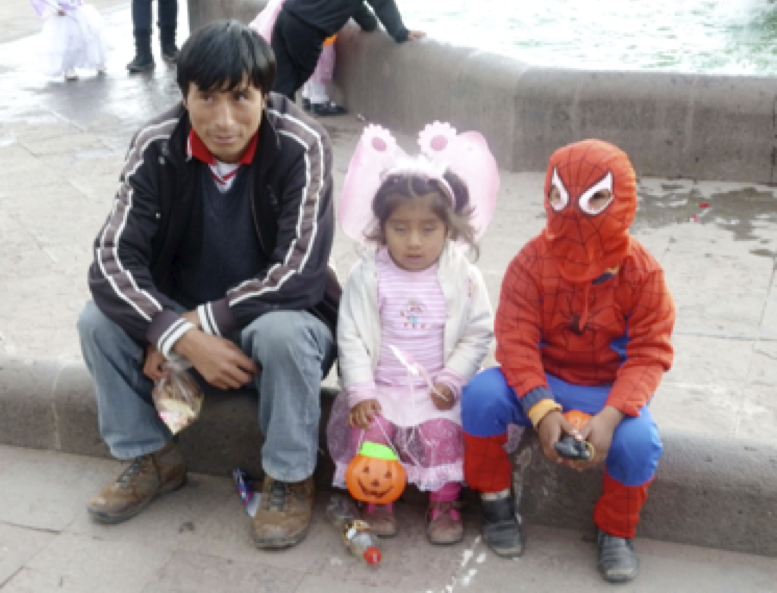
Before dinner at the hotel, I walked through the plaza and watched as the local children celebrated Halloween around the Inka fountain.

rmgphoto12 rmgphoto11

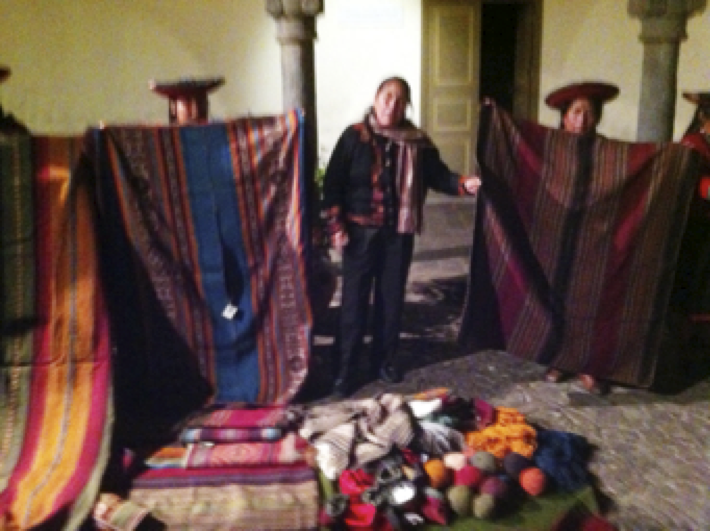
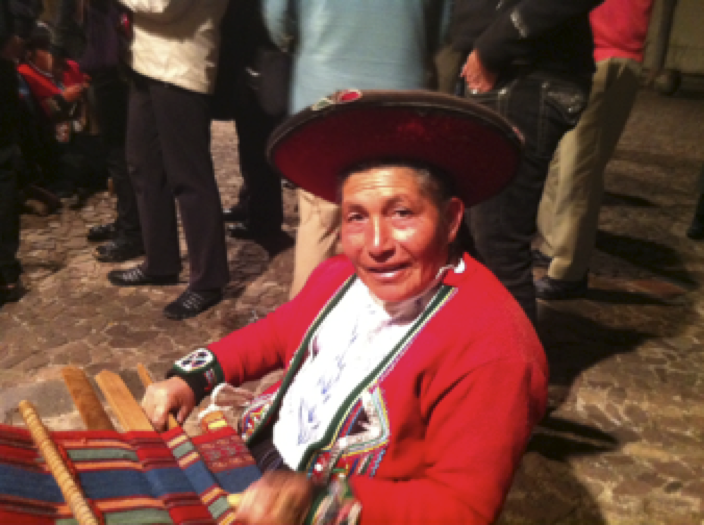
Before dinner we also all went across the street to the ethnographic museum for Pisco sours 9a Peruvian specialty drink) and an exhibition of native women’s weaving. The skill of these women who work with a variety of small hand looms, the intricate patterns they develop using alpaca thread and natural dyes were amazing. (see photos). All work with a relatively newly formed women’s cooperative that’s striving to reinvigorate the oldest traditions of Indian weaving. I bought a lovely table runner for Thanksgiving from a cheerful young woman about my daughter’s age: it comes with a tag with her picture, name and birthdate.

rmgphoto15 rmgphoto13

Cusco Weaver

DAY 3, FRI., NOV. 1

Today was a day I have waited for since childhood: a visit to Machu Picchu, the sacred Inkan mountaintop city.  Our group split in two, two-thirds of us on buses at 7:00 AM to visit several sites before joining up with the Hiram Bingham train around 11:00 AM, and the other third sleeping in and taking the train all the way from Cusco to Machu Picchu.

Our buses wended their way up the mountainside to get out of Cusco, reaching an altitude of 12,500 feet where, at a rest stop, we had a wonderful view of the snow-capped Andes cordillera to our east. Some of these mountains exceed 17,000 feet. Below us, a river ran eastward: one of the first tributaries of the Amazon.

rmgphotos16

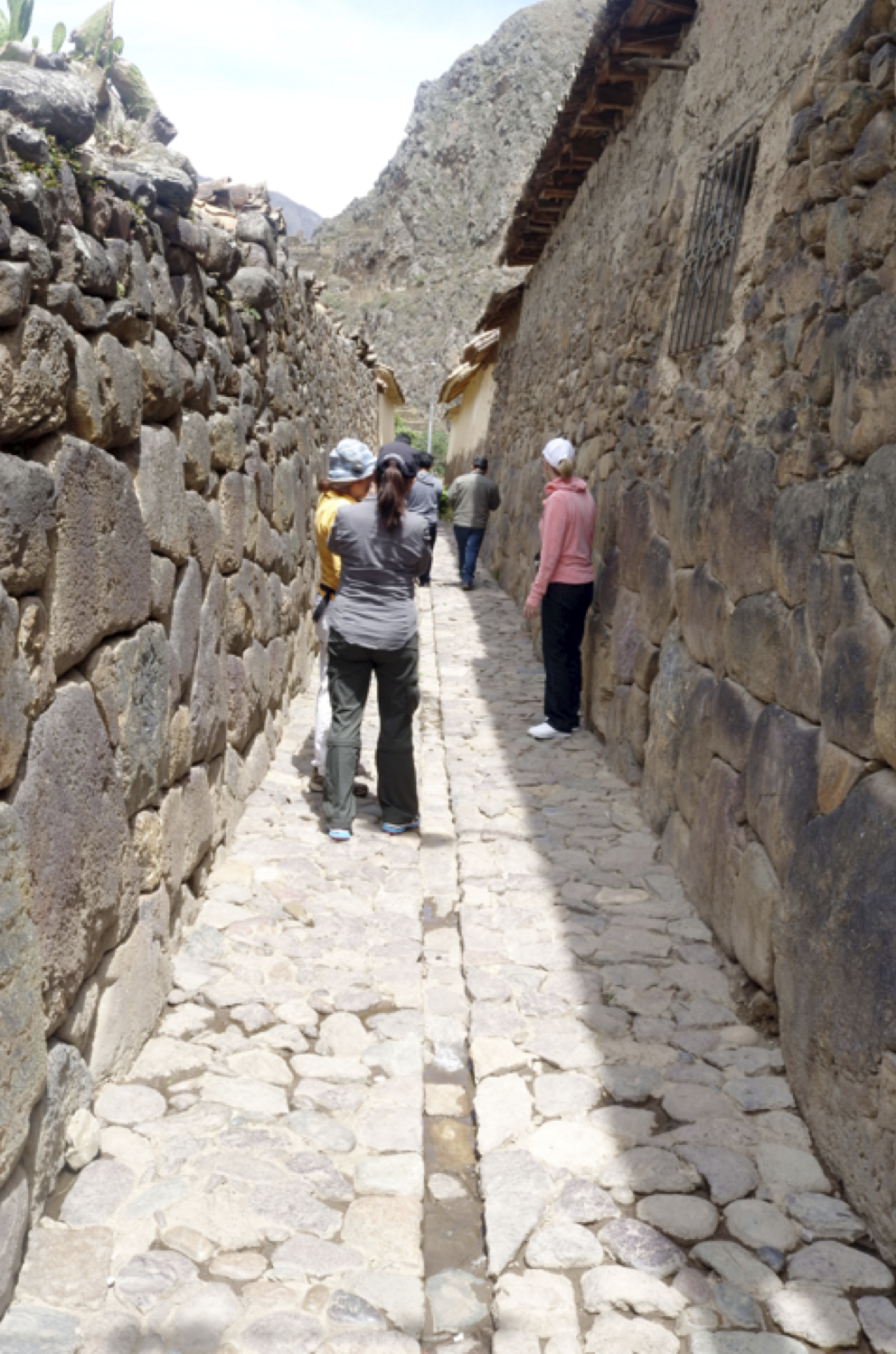
About 9:00 AM we reached the ancient Inkan town of Ollantaytambo (literally the rest stop—tambo—of the warrior Ollantay). This is a charming city, whose house walls display the strength and precision of Inkan stone architecture.

rmgphoto17

Above the town is a large royal and/or priestly compound with a huge complex of stone terraces, which the Inkas used to grow crops (a foretaste of Machu Picchu). The climate in this region (13 degrees south latitude) conjoins uniform warmth with the coolness of a high altitude. It never snows here, and there is abundant water (the winter season is rainy; the summer dry), so it a perfect region to wrest agricultural land from the many hillsides. This, too, is the region where the potato (which likes cool environments) was first domesticated.

At around 11 AM we walked to the train station and waited for the Hiram Bingham train (named in honor of the rediscoverer in 1911 of Machu Picchu) to arrive with our less adventurous fellow travelers. The train, managed by the Orient Express Company, is beautiful. As we descended to Machu Picchu town, about 50 kilometers further to the north and at a lower altitude, we had a sumptuous lunch, marked by several glasses of wine or Pisco sours. Inspector Poirot, move over.

rmgphoto18

Arrival in Machu Picchu town was followed by a bus ride 2,000 feet up the mountainside on an unpaved hairpin road to the entry of Machu Picchu. 1.75 million people visit each year and the admission is about $50, but we were merely whisked in.

Words cannot describe this site. Perched on a mountaintop, with every glance over your shoulder looking down thousands of feet to the valley and river below, it is an Inkan Shangri-La. Acres of terraces, storehouses, religious buildings, and houses—all with massive walls with stones fitted perfectly together and interlocked so as to withstand earthquakes. No metal was used for this work, and, except for dirt brought in in small amounts on llama transports, everything was heaved and hauled by human beings

Most interesting to me were the religious sites. The Temple of the Sun is situated so that, on the mornings of the winter and summer solstice, sun passing through “gates” on two higher mountains penetrates openings in the building’s wall and shine on the altar. With the sun god, Inti, given offerings and worship by the priests, this assured the Inkas that the sun would proceed on its course and not go away forever. Another high point holds a sundial that marks out the four cardinal points and provides cosmic orientation. I could have given a lecture on the spot about the religious importance of cosmology and cosmogony. As is, when I finish my Easter Island lecture, I will tell the travelers that “next week there will be an exam in which they must apply these comparative religion concepts to Machu Picchu.”

rmgphoto19

rmgphoto21

rmgphoto20

rmgphoto30

rmgphoto31

Exhausted by walking the ups and downs of the myriad steps and terraces at high altitude, our group returned to the busses and the Hiram Bingham train. After a wonderful dinner and rattling through the night back to the hotel, we all flopped into bed, in my case sleeping soundly until the next morning.

DAY 4, SAT., NOV. 2

This morning had us off to the Cusco airport, and then to Lima. After small delays we arrived at our wonderful Icelandic jet and boarded for Easter Island.

Following lunch service, my colleague Fred Diehl, a biologist from UVA delivered his first lecture: “Observing: Birds” which was his preamble to a series of lectures on how to understand features of the biological environment. After a short bathroom break for everyone, I followed with “Mysteries of Easter Island.” All the technology worked, and I received numerous handshakes and questions on my way back to my seat.

Late in the afternoon, our pilot announced that he had been given permission to twice circle Easter Island so that we could all see it from the air. Quite a privilege!

Sad to say, my camera battery had run low (and the recharger was in my suitcase below), so I had to use my iPhone to take pictures. In the first of these you cannot really see Tongariki Ahu, the long line of Moai (great statues) that line the shore to the center of the small bay near the center of the picture,

rmgphoto40

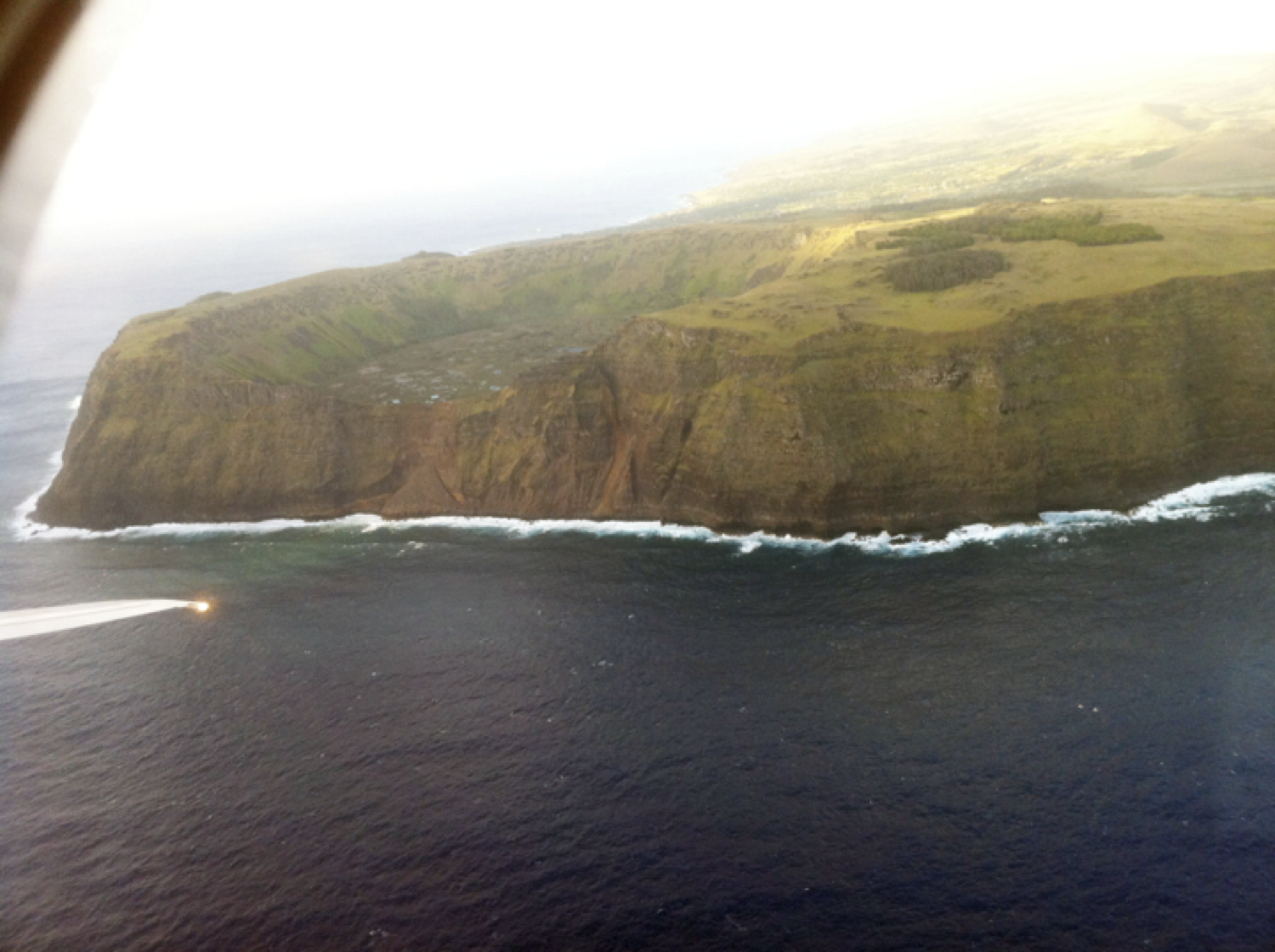
The next photo is of the volcanic crater that marks the western end of the island. Beneath the cliffs here, the ritual swimming race of the birdman cult takes place.

rmgphoto42

Days 1 – 4

Aside
Travel

DAY 5, SUN., NOV. 3 EASTER ISLAND

Easter Island! The name* brings me back to my youth, when I first read Thor Heyerdahl’s Kon-Tiki. Modern DNA analysis, linguistic and material evidence have largely discredited Heyerdahl’s thesis: that the Polynesian islands were first settled not from the west but from the east and that the same architects who built Machu Picchu carved and raised Easter’s great statues, the “moai.” But Heyerdahl’s bold effort to cross the 2,300 miles of open ocean from the South American coast on a reed raft inspired interest in Easter island, and his early archeological work, although now mostly surpassed, contributed to the growing body of knowledge about this extraordinary island “at the end of the world.”

*NOTE: the name “Easter Island” has largely been replaced by the name “Rapa Nui,” which the islanders use today. But this name only arrived in the mid-nineteenth century with travelers who invented it, Rapa Nui means “large Island.” I will use both names interchangeably.

After a good night’s rest and dinner in our beautiful hotel, the Hangaroa Eco Lodge on the edge of the western coast of the island (the Lodge’s roofs are covered with grass, (Some photos),

Image

Image

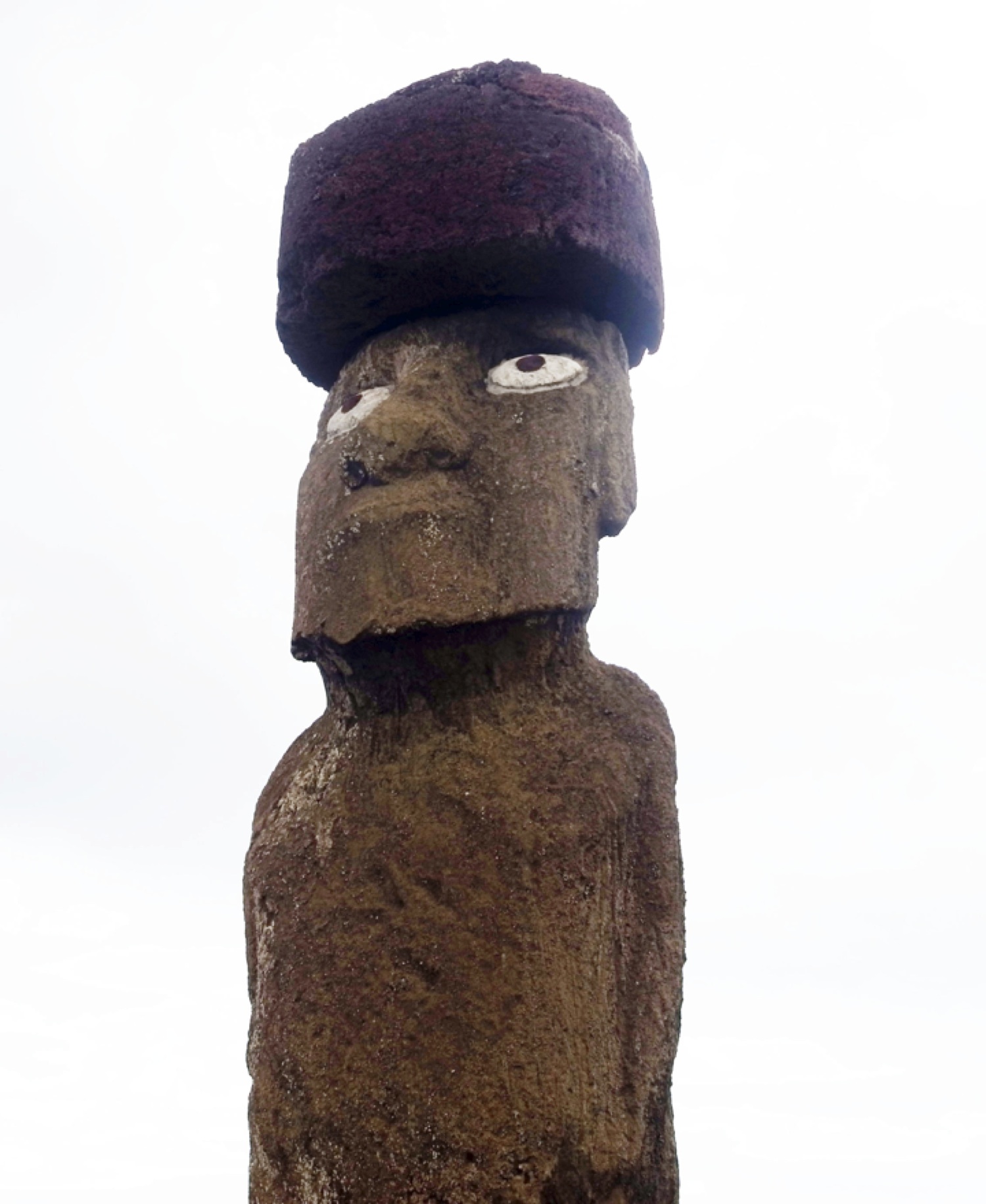
we set out on our morning excursion. First stop: Ahu Tahai. This is a ritual sacred altar beside the sea, on which is placed one of the largest of the moai—and one of the few with its red scoria topknot in place, and one of the only ones whose white coral eyes, with their red scoria pupils, have been inserted. The eyes, we learned from our anthropologist guide Claudio Christin, were only inserted for ritual events. Doing so awakened the statue, representing a sacred ancient ancestor, making him receptive to the offerings of his human kin.

Image

From Ahu Tahai, we traveled eastward, almost the full length of the island to the Rano Raraku volcano and quarries. These quarries, which girdle the volcano, are the birthplace of all the moai. They were carved out of the volcanic tuff and transported from here throughout the island, a distance sometimes as great as fifteen miles. One of the “mysteries” of Easter Island is how the islanders transported statues (887 have been found) weighing up to 80 tons down the sides of Rano Raraku and across miles of fields and hills. (There are currently several competing theories about this question. Claudio Christin had a very persuasive one, which you will have to come to Easter or read his new book to learn. His theory does not involve extraterrestrials.)

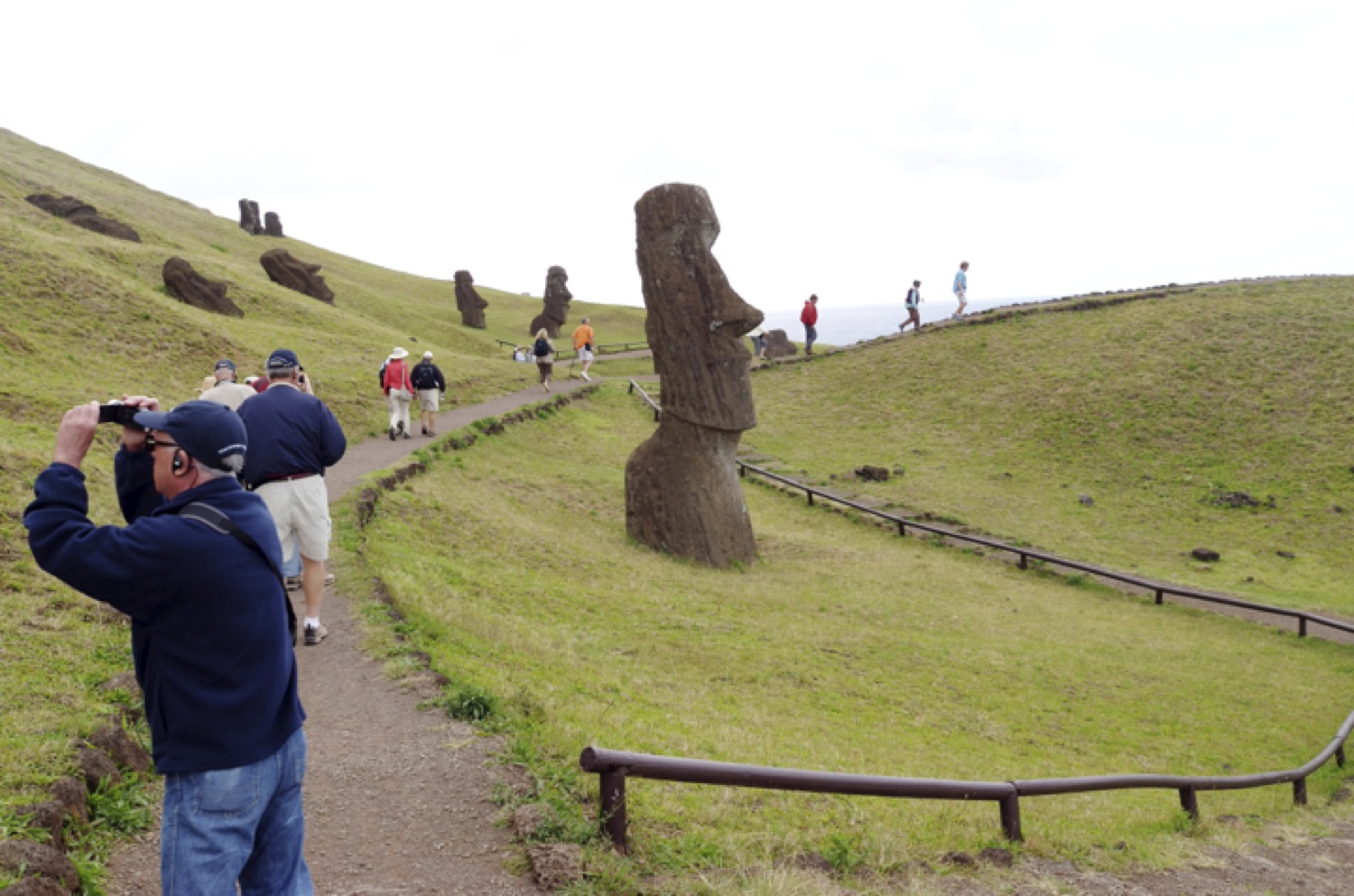
We took the path up the side of Rano Raraku to one of the many quarries that ring the hillside. Beside the path lay many moai whose fragile tuff broke en route and that were abandoned in place.

4-QUARRY PATH

At the quarry,

5-QUARRY 1

we could see an unfinished moai, which Claudio estimates would have been about 50 feet tall and weigh 90 tons. This was apparently a “moai too far,” one that probably should never have been attempted in the first place since it would have been extremely difficult to transport.

6-QUARRY UNFINISHED 1

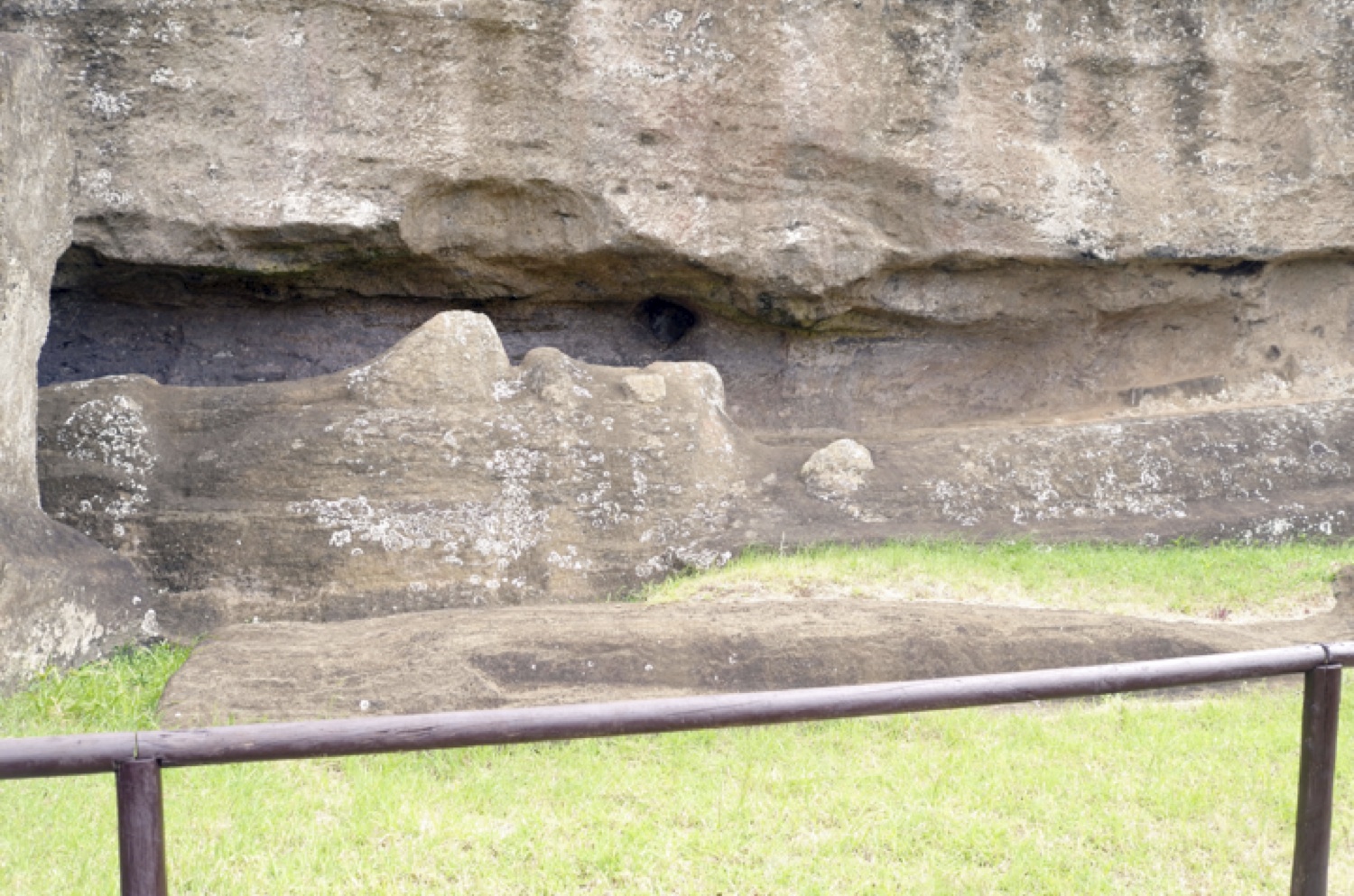
Here, too, is another moai that never made it out of the womb

7-QUARRY UNFINISHED 2

Sculptors were not “professionals” and Rano Raraku was not a professional moai “factory.” Those producing a statue usually came from a village clan and worked on site to produce their clan’s newest moai (like humans, the older ones, representing distant ancestors, tended to die away in power). They would carve the statue out of the tuff, leaving a “keel” underneath to keep it in place until they were ready to cut the keel and start the moai on its journey. This behemoth, keel in place, never made it out of the womb.

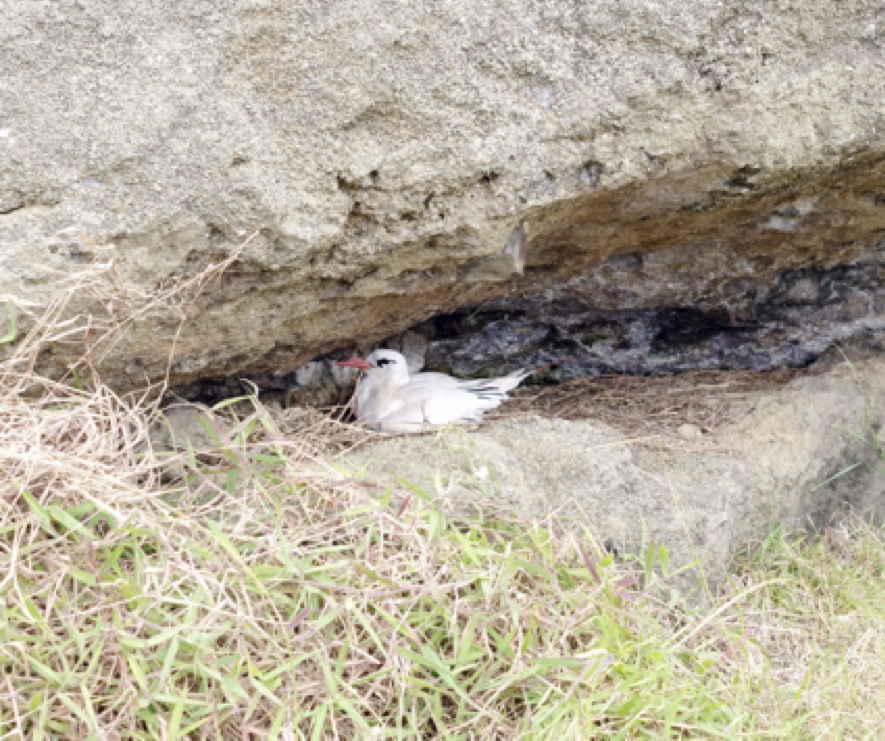
Walking back down the hill we sighted a male red tailed tropic bird in a niche, taking his turn on the egg (while his wife was presumably out shopping).

8-BIRD

From the hill, within eyesight from Rano Raruku we could see Ahu Tongariki.

9-AHU TONGARIKI 1

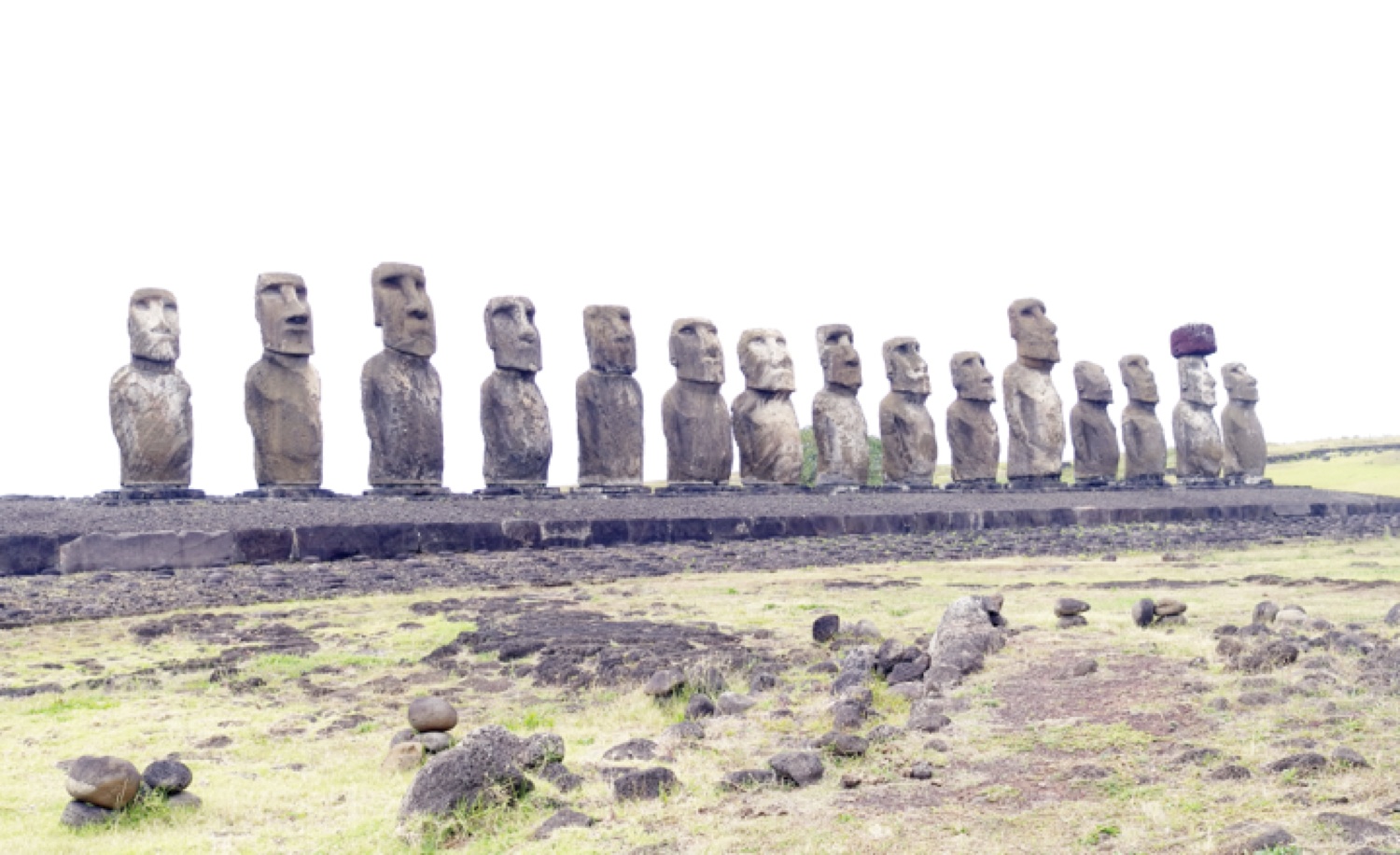
This lineup of fifteen moai facing the volcano and with their backs to the sea is one of the wonders of the world and alone merits a visit to Easter.

Some of these moai had been toppled in the clan wars that marked the end of the great period of Easter Island religion and building (the mid-sixteenth century). The rest were scattered and leveled by a thirty-foot high tsunami in 1961. Claudio told us how, as a young archeologist, he received a call early one morning from the Chilean ambassador in Japan who told him that a Japanese industrial corporation was willing to donate a 55-ton crane for the restoration of the site. Thus began a five-year effort led by Claudio, and involving up to fifty people, for which we are all indebted.

10-AHU TONGARIKI 2

11-TONGRARIKI 3

After a barbecue lunch on Anakena beach around the north side of the Island (yes the water here is that blue),

12-ANAKENA

Patricia Vargas, Claudio’s ex-wife (the two came to Easter just out of graduate school in Chile and raised their family here) took a part of our group on a walking tour of Ovahe beach on the north coast. For over two miles, we picked our way across fields littered with small volcanic stones to get a real glimpse into the domestic life of the early islanders. Things we might have passed by or stepped over of great archeological significance were brought to light by Patricia’s skilled commentary. Here is Patricia pointing out a stone oven that, in the absence of wood, used grass or twigs to cook the family’s meals

13-PATRICIA

And here is a Rapa Nui chicken coop. Chickens, the only domesticated animal on the island, were a family’s treasures. At night the chickens were stuffed into the chicken house, and a stone was used to conceal the entrance. In this way, island families tried to reduce chicken rustling, although we learned that it sometimes happened and could lead to violence.

14-COOP

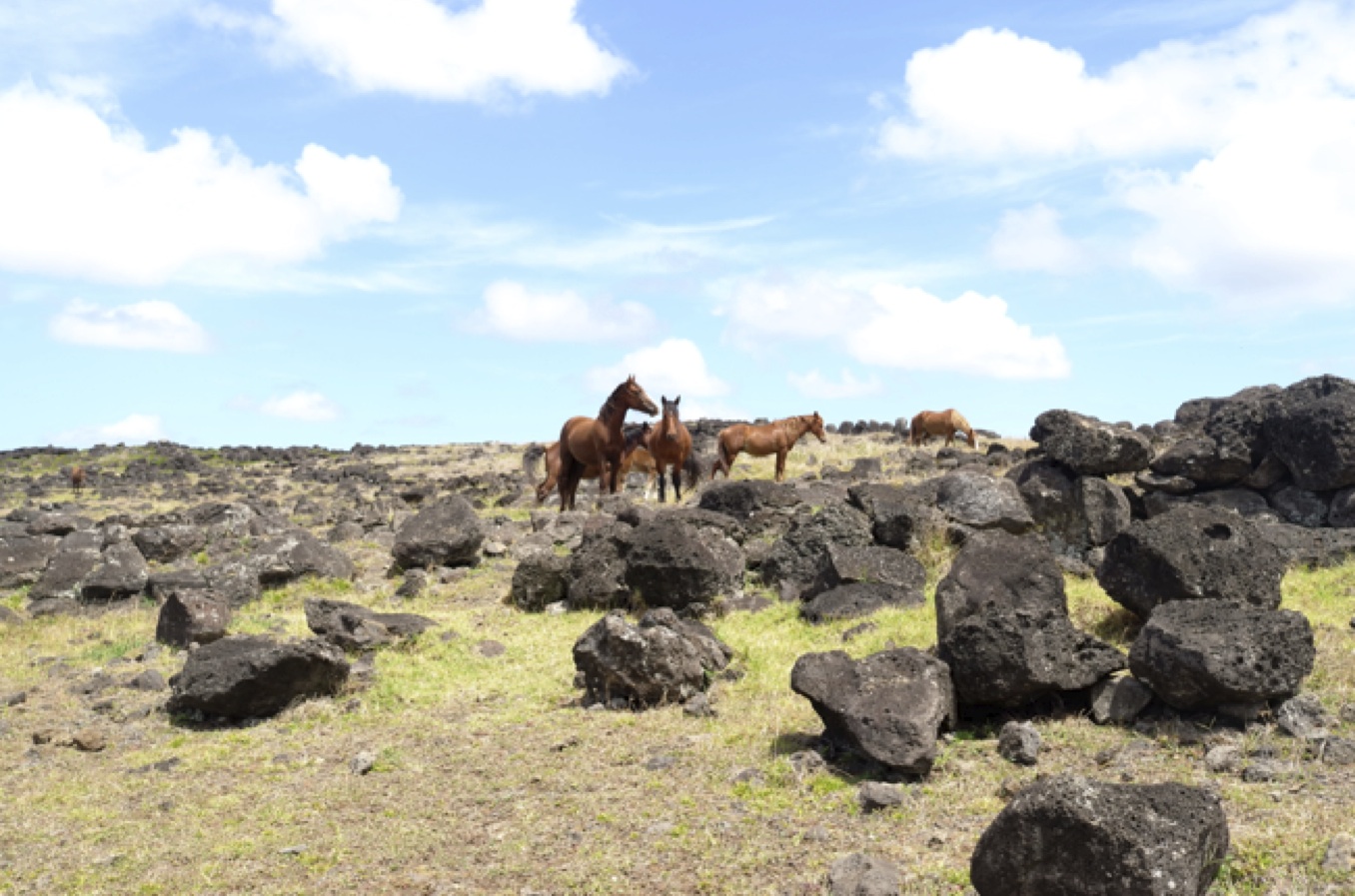
As we walked, herds of wild horses galloped past. Several thousand of these beautiful animals live free on the island. Some are “owned” by teenagers, who occasionally tame, ride, or race their favorites.

15-HORSES 1

16-HORSES 2

The rocky shore of the island is also littered with the bones of horses who perished from sickness or age, or who could not survive a bad growing season.

17-HORSES BONES

Sunday evening began with brief remarks by the three archeologist/guides for our visit, Eduardo Martinez, Claudio Christin, and Patricia Vargas.  (Eduardo has just published the fruit of his lifetime of work on the island as When the Universe Was an Island and Claudio and Christin have just published Easter Island: Silent Sentinels. Both books should be available on Amazon). In her remarks, Patricia touched on her belief that Easter represents the best and the worst of the human condition. The worst because of the environmental disaster and fratricidal wars that ultimately decimated much of the population; the best because of the islanders’ marvelous cultural creations and the spirit that produced them, which still lives on.

The archeologists were followed by an example of that spirit: a lively and vigorous company of native female and male dancers.

18-DANCING

For a moment, one had the sense that in its heyday, Easter was not all ritual and wars, but maybe, too, a fun place to be.

Standard
Travel

DAY 6, MON., NOV. 4

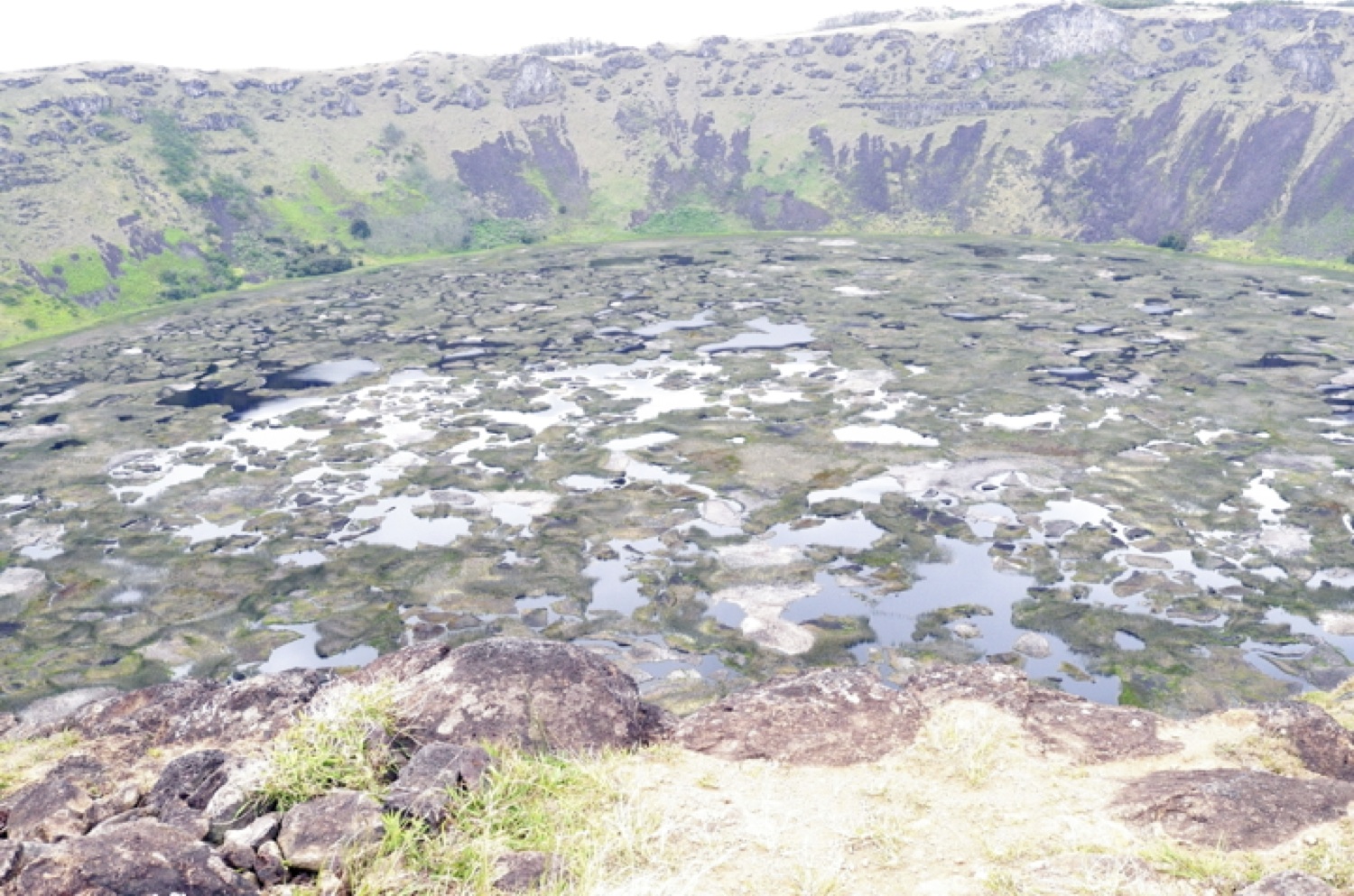
Up and early, we headed to the top of the caldera that anchors the western tip of the island. This volcano, whose rim at its center is a mile wide, and whose bottom, 600 feet below, is filled with huge reed matts covering much of the surface of water that reaches ninety feet deep at the caldera’s center, was the jumping off point (literally) for the bird man cult.

1-CALDERA

This cult may have had more ancient predecessors, but it flourished in the wake of the fratricidal wars that tore Easter apart in the sixteenth century, when the large palm trees disappeared and life on the island became a bloody conflict over scarce resources. The cult seemed to offer a way of reducing conflict. Each year, on a ritually appointed date just before a colony of sooty terns returned to small rocky island a few hundred feet from the base of the caldera, swimmers would race down the slope of the volcano and defy powerful currents to reach the island and find the first tern eggs of the season.

2-ISLANDS

The athletes were sponsored by well to do men on the island, and when the winner returned to the ritual site with the precious egg, his boss would be appointed island king for the year, with almost absolute power over the feuding clans. Although a seemingly clever solution to the problem of conflict, it did not always work well: rival clans would resist the boss’s edicts, and those edicts themselves were often so arbitrary and self-serving that they led to new conflicts. Christian missionaries eventually put an end to the cult. I strongly believe that religion and ethics (in the sense of reasoned systems of thought aimed at reducing social conflict) often go together, but the Birdman Cult shows once again that (religious) solutions can sometimes be worse than the problem.

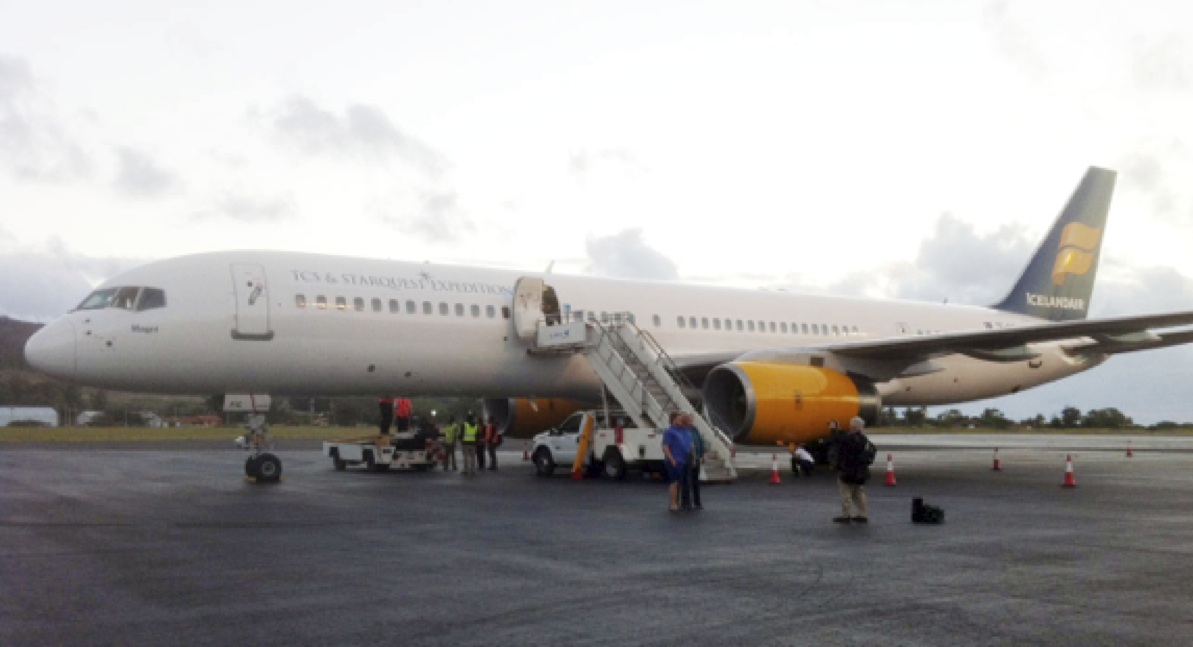
Returning to the Eco Lodge for lunch, we grabbed our hand luggage and headed to the airport for the next leg of our journey, a ten-hour flight to Western Samoa, with one stop for fuel in Papeete Tahiti. At the airport, we had to be screened, but since there were no other departures, we immediately walked across the tarmac to our waiting jet.

3-JET

Standard
Travel

DAY 9, THURS., NOV. 7

We arrived last night in Cairns, Australia, and transferred to our hotel, the Sea Temple resort, in Port Douglas. This is in the state of Queensland on Australia’s northeast coast, a tropical part of the continent.

There were two choices for today’s excursions: snorkeling on the barrier reef or a series of visits to indigenous tropical sites. Snorkeled out from Samoa, I chose the latter—and never looked back.

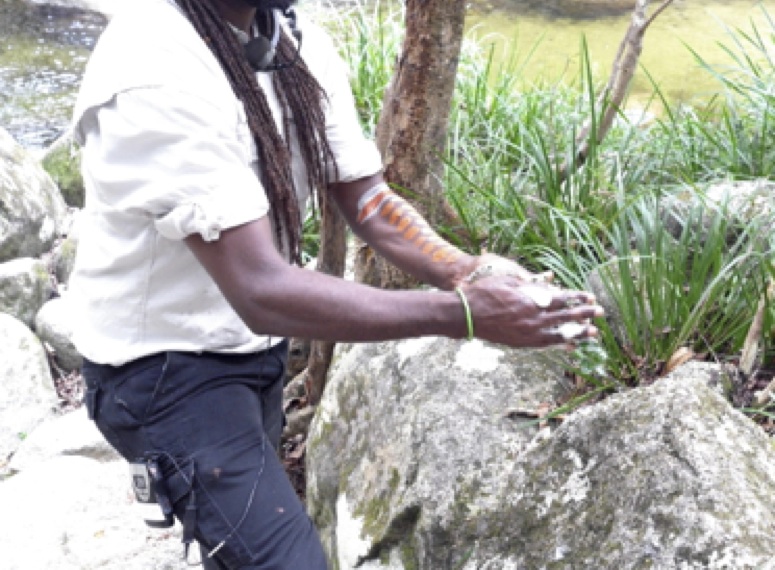
Our day started with a visit to the Daintree Rainforest, where native, aboriginal guides greeted us. Cameron

1-CAMERON

took us on a “walk about” of a small sector of the forest. He explained what we were seeing by recalling his own many “walk abouts” with his grandfather when he was a boy of ten or eleven. It’s crucial for aboriginal youngsters to learn the ways of the forest, from how to gather food to how to avoid the very dangerous cassowary birds, which, if they are antagonized or think you’re near their nest, can chase you at speeds up to 50 km/hour, and disembowel you with their large spiked claws. Cameron pointed out that cassowaries are crucial to the survival of the rain forest because they eat fruits that are toxic to most other creatures and poop their seeds all over the forest, thus aiding plant propagation. There are only 1,000 of these birds left in the wild, so efforts are being made to protect them.

Taking us to the bank of a clear running brook (the Mossman river, I think), Cameron showed us how his people use local ochre, charcoal, and clays to paint their bodies with marking signs (including signs that indicate the limits to their own and other tribes’ territory, the latter of which they must not trespass on lest violence break out).

2-ARM

After painting himself, Cameron gathered a handful of leaves from a nearby bush, which he crushed and mixed with water, yielding abundant lather. “The soap bush,” he explained. Twigs of the same plant are also an all-purpose liniment.

3-WASHING

This pointed up not just the depth of knowledge of aboriginal peoples but the still undiscovered treasure in botanical products contained in these endangered rainforests. (All around the world, we learned, a football-field sized portion of rainforest is destroyed every second.)

Having lectured on the concept of the sacred and profane a few days ago, I was pleased to see that just about every one of Cameron’s description of sites in the forest mentioned sacred places and things. Women, it seems have their own, separate sacred sites, and these are taboo to men (and vice versa). As a youngster, Cameron underwent his rite of initiation here, being left alone all night in the forest as a test of his manhood. Fortunately, he did not bump into a cassowary.

From Daintree we headed to a remarkable site for lunch: the Botanical Ark. This is the home and project of a couple named and Alan and Susan (I didn’t quite get their last name). For the past four decades this couple have been collecting tropical nut and fruit trees and plants from rainforests all over the world for planting and preservation on their twenty-acre property. Before lunch, Alan took us on a walk-about as well, beginning with Heliconia palms, whose flowers, like bird of paradise plants, are thick waxy and startlingly colorful.

4-HELICONIA

Realizing that these flowers remain beautiful for six weeks or more, Alan and Susan began a floral business, shipping Heliconia to hotels and business around the world. To this day, they are a popular decoration in hotels across Asia. Unfortunately, a six-month-long commercial air pilots’ strike made the business untenable for them in this remote corner of Australia, and Alan and Susan went on to other things.

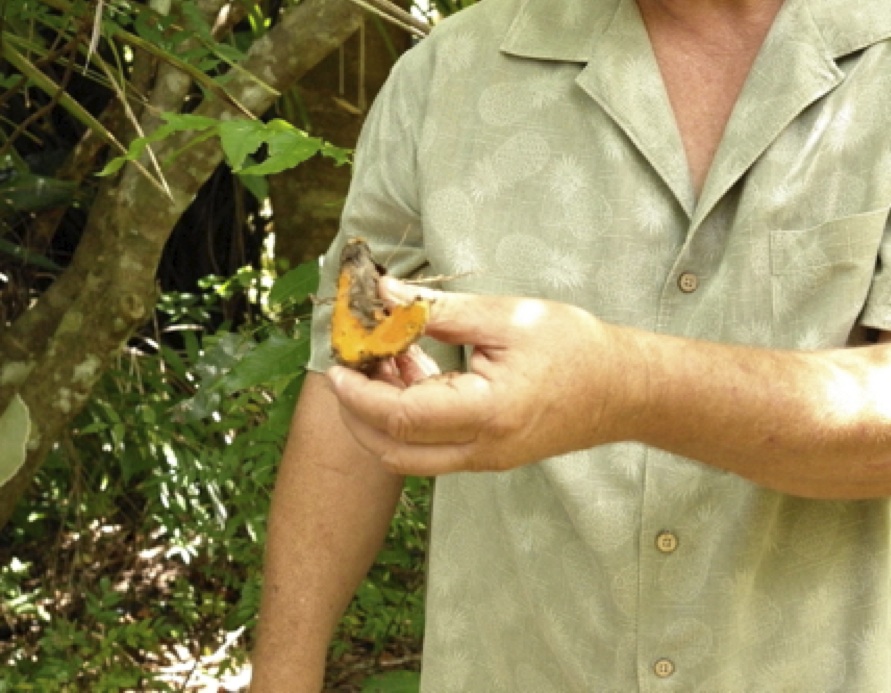
Our tour introduced us to many other unique and rare tropical plants, including bright orange turmeric ginger, which is currently being researched for its potent anti-cancer properties. (The Botanical Ark is a world repository for over 500 types of gingers.)

5-TUMERIC

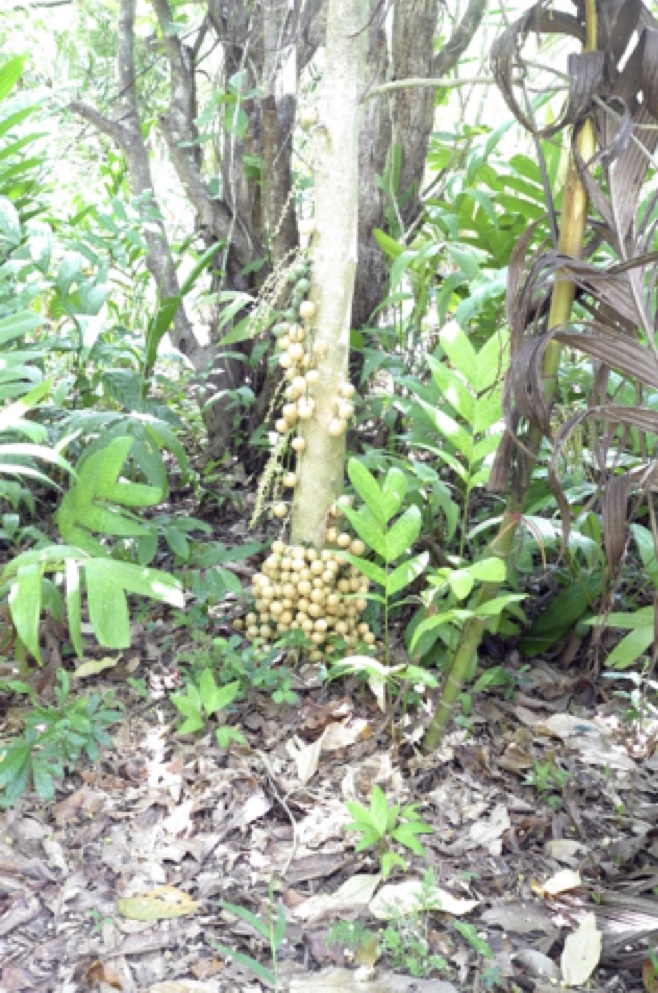
Another plant, which Alan said it took twenty years to develop, is the Kepel Apple. Unlike most fruits, this one grows on the trunk of the tree.

6-KEPEL 1

7-KEPEL 2

The Kepel Apple is historically reputed to have been a favorite in royal gardens across Asia as a fruit that “sweetened” bodily odors. When, after years of waiting, the first tree had produced enough fruit, Alan gave it to two friends, and he and they each ate about ten small apples. The friends reported that after a vigorous, sweaty workout session at the gym, they received numerous and unsolicited compliments, on their “lovely citrusy odor.” A European pharmaceutical company is currently researching the fruit for its active ingredients. Will the day come when we’ll replace our deodorants with a pill or breakfast of cereal with Kepel Apple slices? If so, thank the rainforest.

Our walk ended with some frolicking with Alan and Susan’s Labrador retriever whose energetic pursuit of sticks in our hosts’ beautiful pond showed how true she is to her breed’s name.

8-DOG

When we first arrived, we were met with this bouquet of tropical fruits grown here and were served fried breadfruit with guanabana juice (a thick, creamy white tropical nectar).

9-FRUIT DISPLAY

Lunch continued this theme with a repast of local botanical products, including this salad of mangoes, and three other fruits whose names I can’t recall.

10-FRUIT PLATTER

The visit made me realize that our diet of apples, pears, bananas, etc. hardly touches the richness of fruits that can be cultivated. Perhaps our grandchildren will someday buy fruits like these at the local market.

Our excursion day ended with another wonderful visit, this time to “Habitat,” an amazing zoo where all the residents, including birds, range free in net-enclosed spaces. Here were all of Australia’s unique (often marsupial) fauna. A local variety of storks (I didn’t record the precise name),

11-STORKS

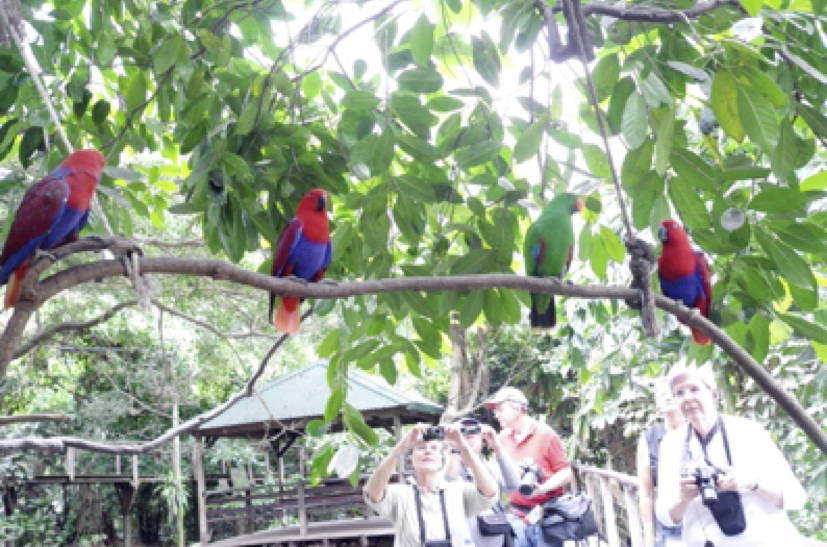
parrots (all the same species; the green one is male; the red and blue ones are females),

12-PARROTS

an emu (a large flightless bird like the ostrich),

 13-EMU

a huge local species of pelican (up to my chest in height; three times as big as its Sanibel cousins, and the only bird whose residence in this idyllic spot I regretted: not enough room for him to fly)

14-PELICAN

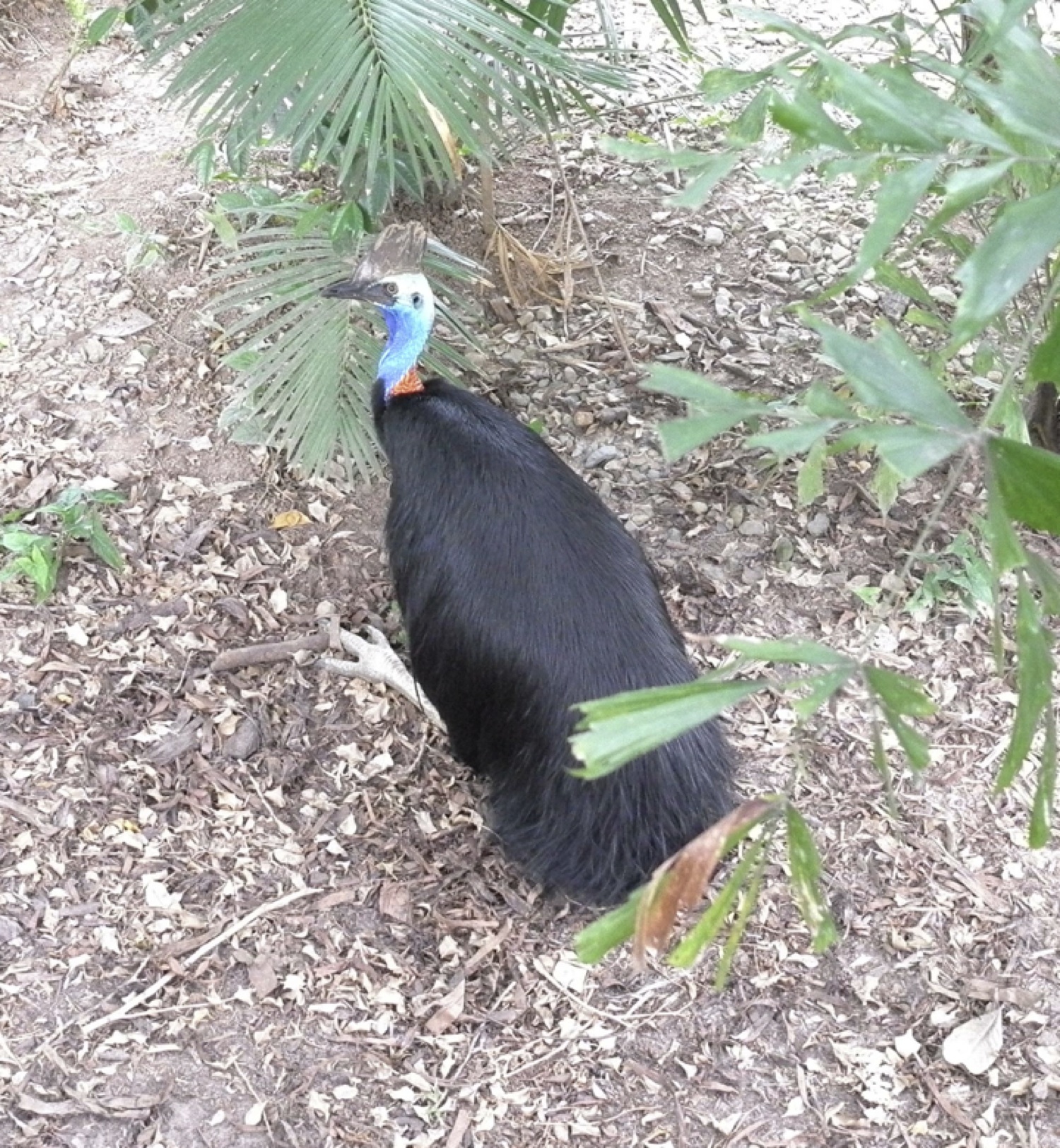
And yes, the dreaded cassowary. This photo doesn’t do justice to its size. This bird is at least as large as a Saint Bernard. No one quite knows the purpose of the structure on its head. A sound receiver? Battering ram? Your guess.

15-CASSOWARY

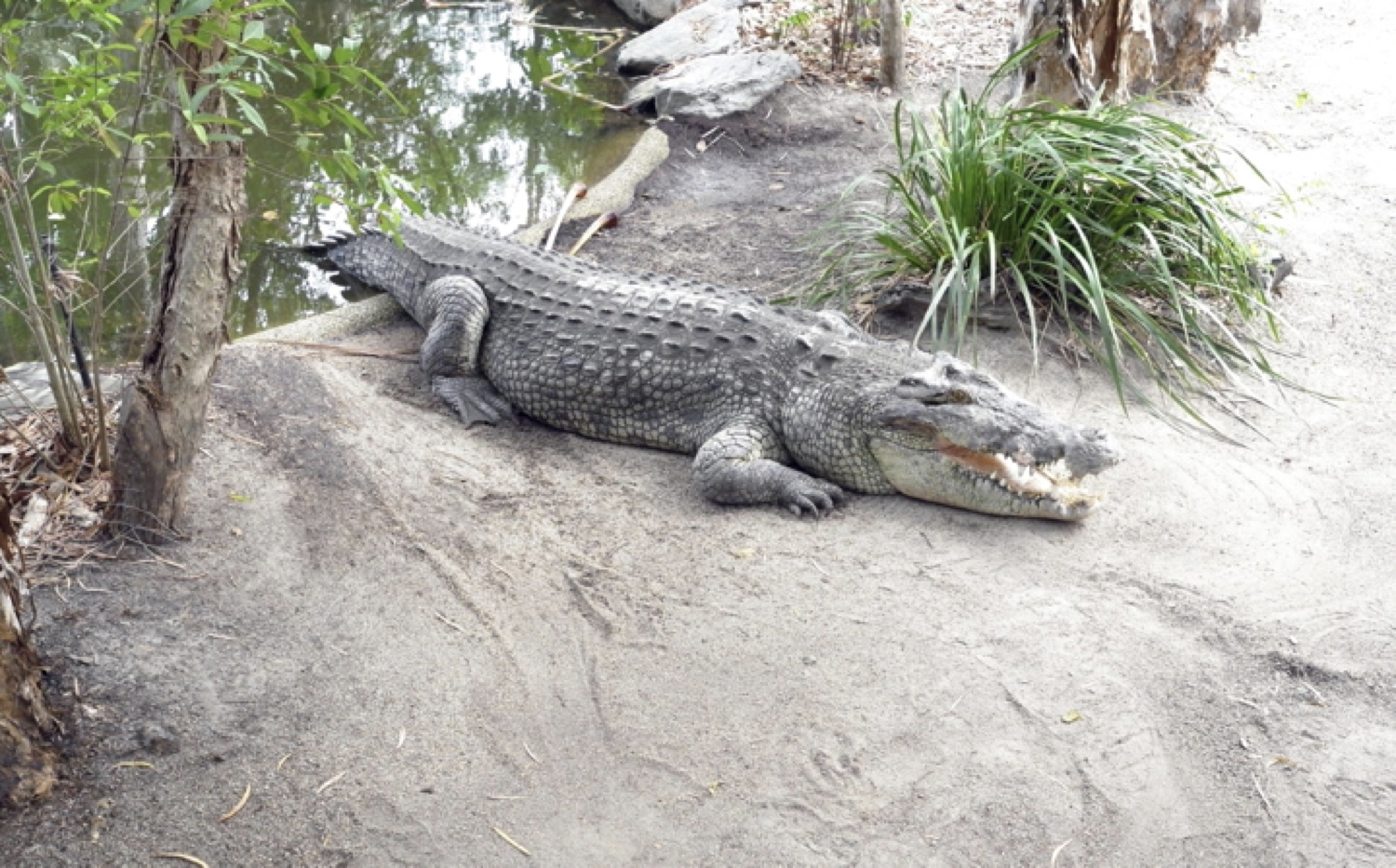
Even more fearsome was the salt-water crocodile, whose jaws, we learned, have the strongest biting force in nature. This scary fifteen foot long specimen is in the zoo because he developed a bad habit of getting too close to human beings at the seashore. You can imagine how nervous I was as I leaned over the fence to take this picture.

16-CROC

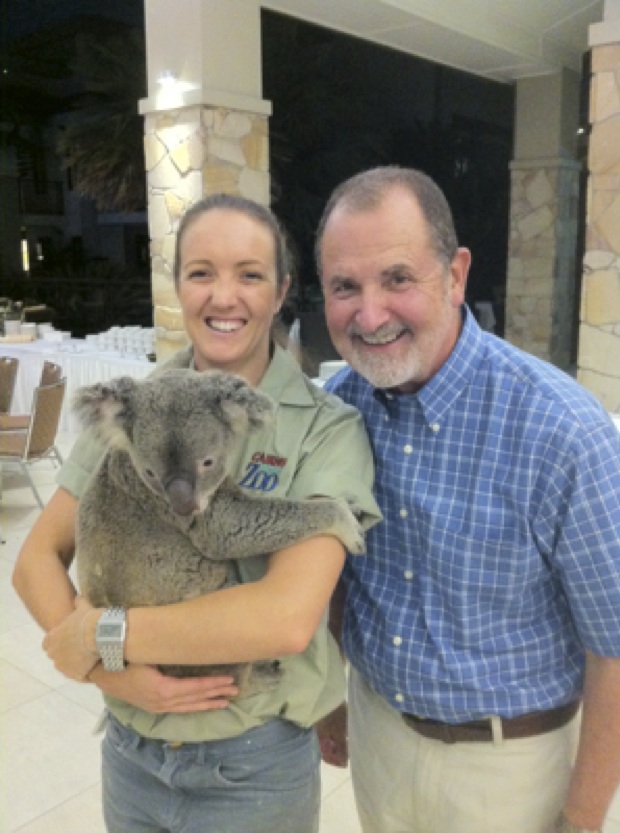
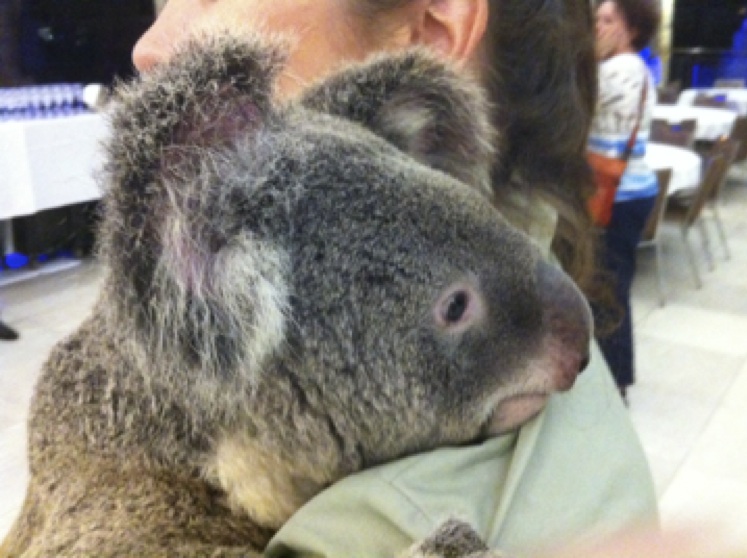
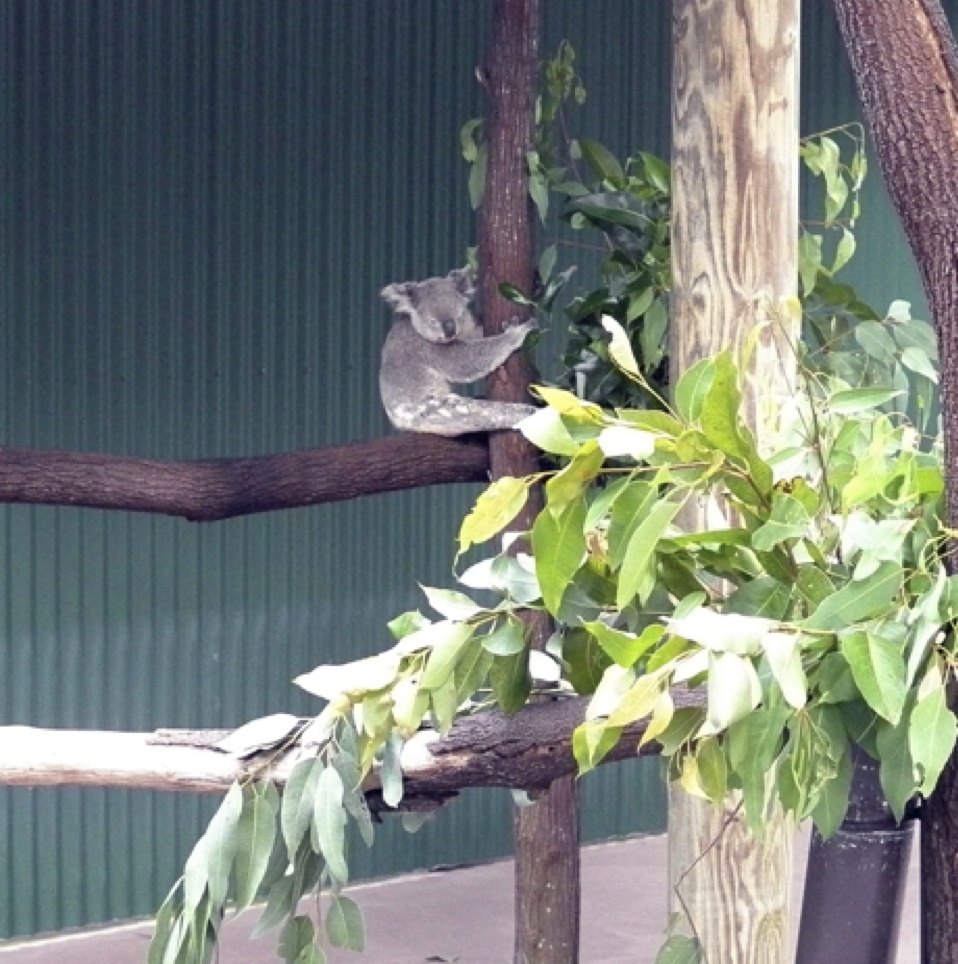
Of course there were koalas (their nutritionally poor diet of gum tree and eucalyptus leaves barely supports life, so they sleep 20 hours a day).

17-KOALA

One whole section featured kangaroos

18-KANGAROO

and wallabies (small versions of the same).

19-WALLABIES

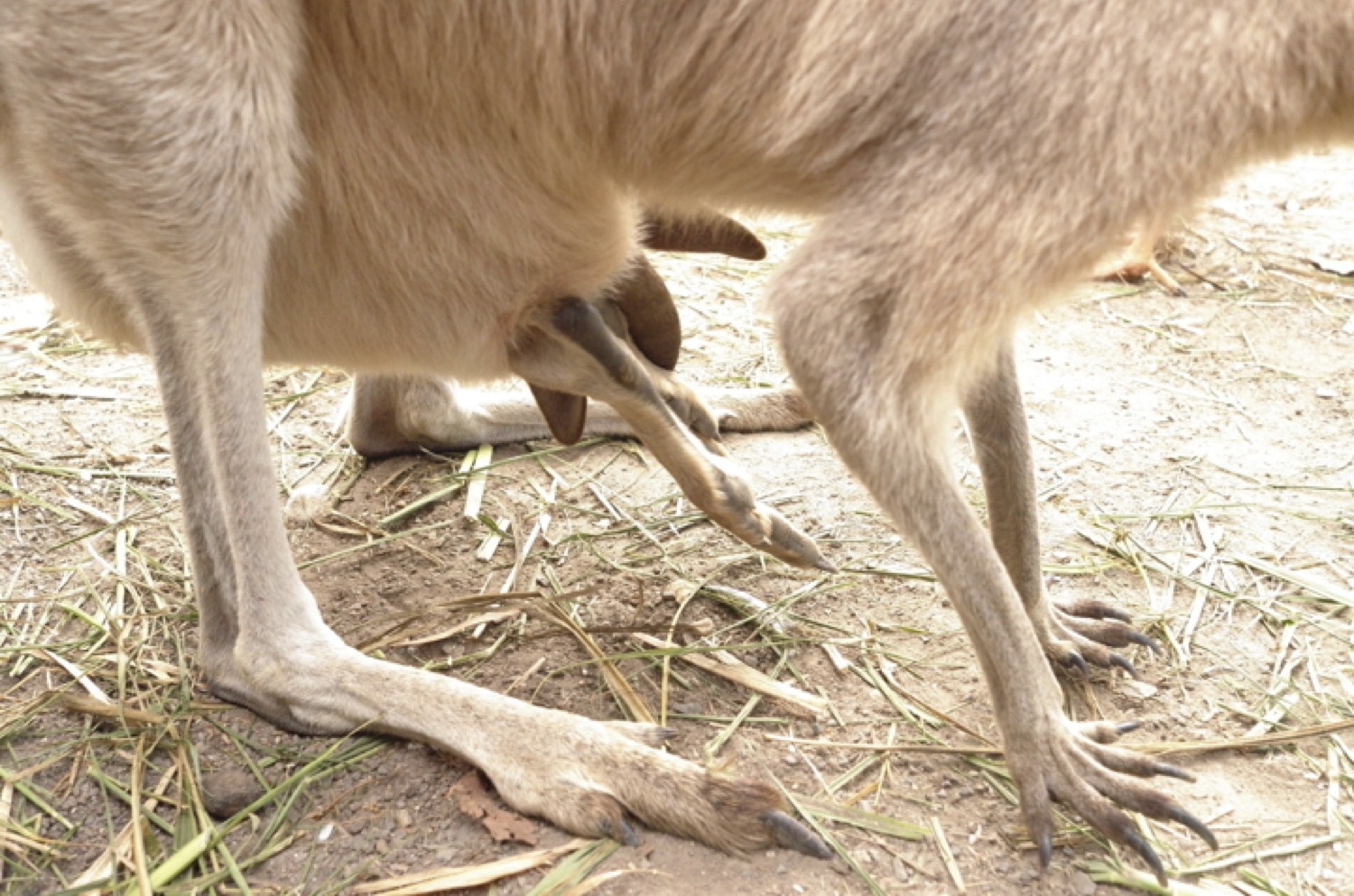
And here are my favorite photos of the visit. First, a mother wallaby with a filled pouch; then the same mom, close up, with the “joey” (baby’s) legs hanging out of her pouch.

20-POUCH 1

21-POUCH 2

Evening, and dinner was dining on our own (with vouchers) in Port Douglas. Fred Diehl, I, and Kassi, one of the travelers, had a great meal at “On the Inlet,” a seafood restaurant on the harbor side. Drinks included very good XXXX beer (so named because the brewers “didn’t know how to spell beer.”) Australia is certainly a fascinating and civilized place to visit. This Queensland tropical zone merits a return.

Standard
Travel

DAY 10, FRI., NOV. 8, DAY 11, SAT., NOV 9 ANGKOR, CAMBODIA

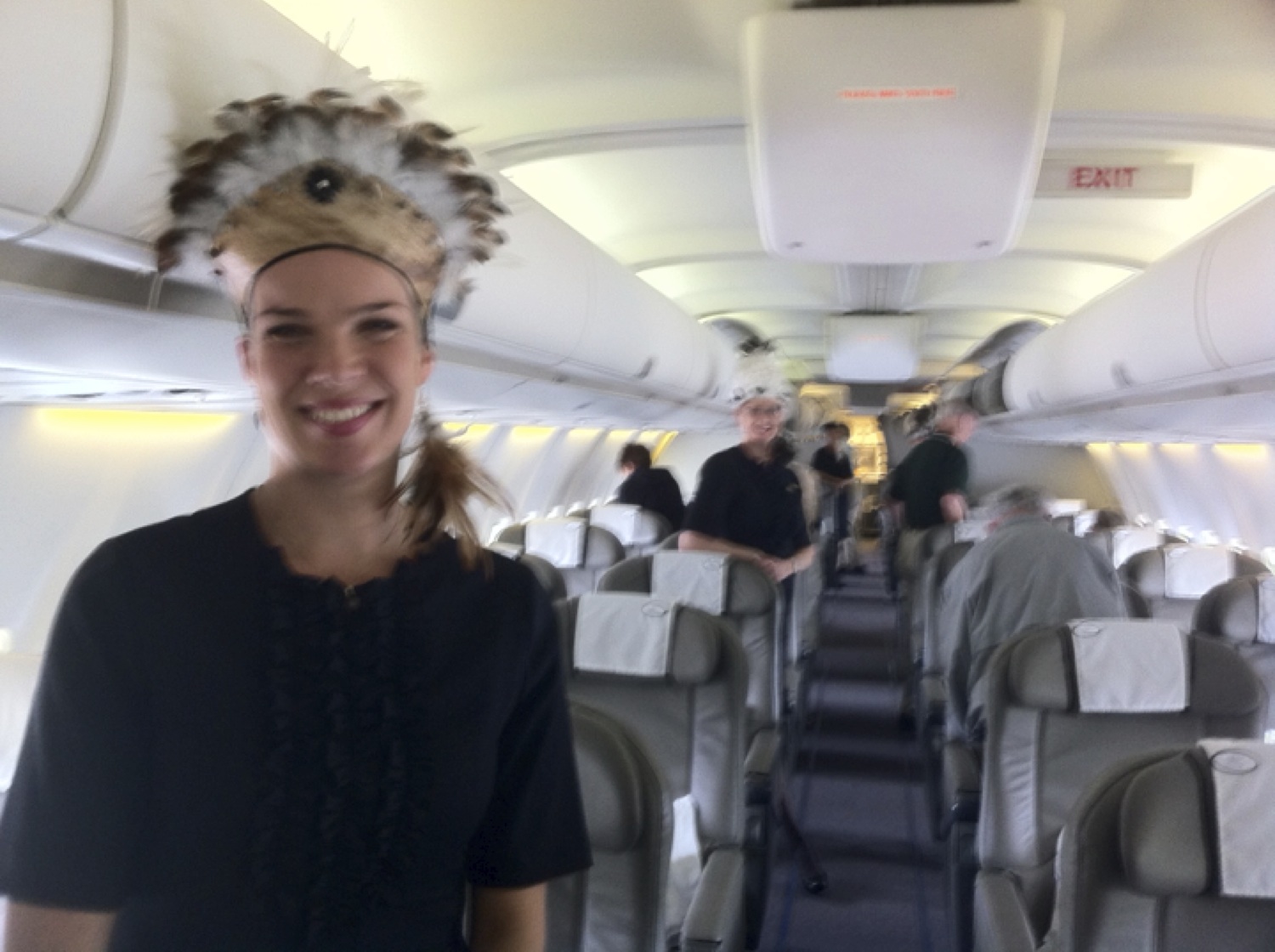
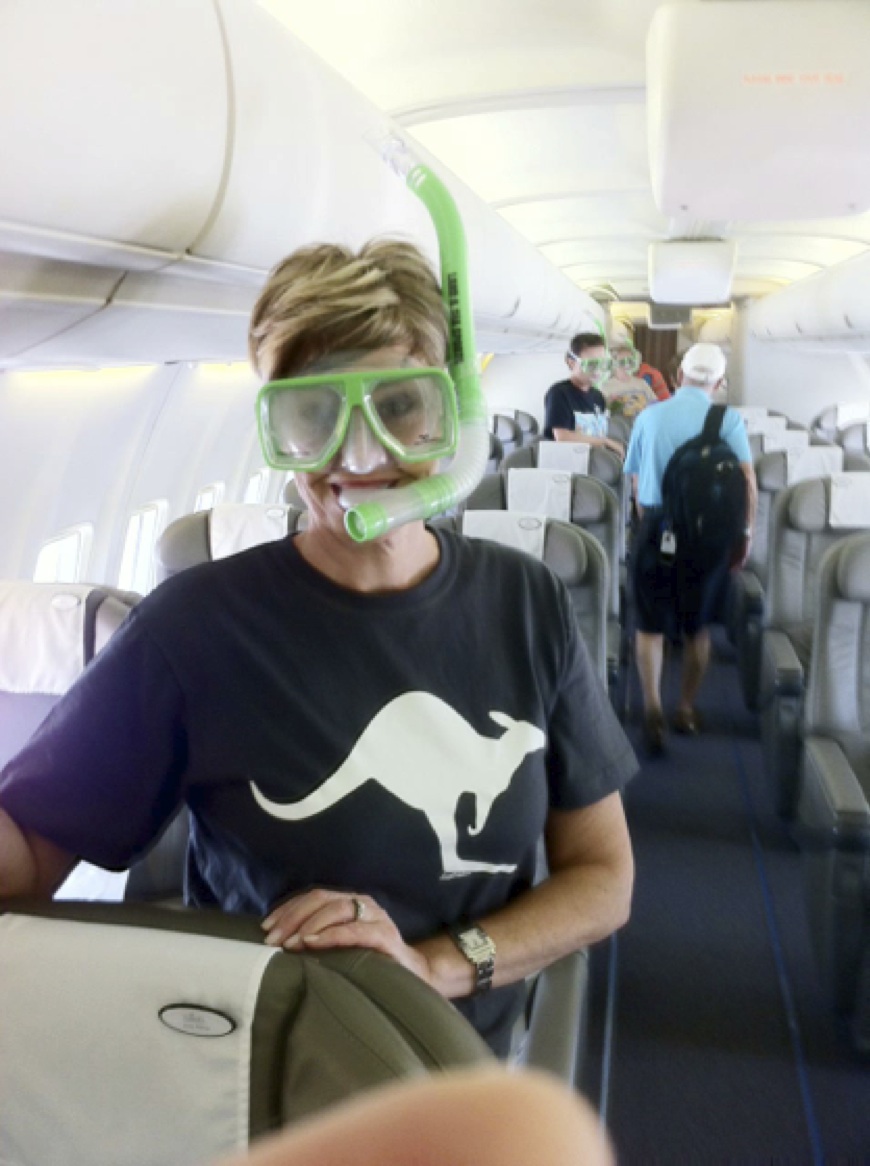
On our departure this morning from Cairns, we were welcomed aboard by our cabin crew in “native costume” for the barrier reef:

1-CREW SNORKELING

The 7 ½ hour flight went by fast for me since I had to lecture on “Angkor: Cosmogony and Cosmology in Stone.” I think it went well. (The next day, local guides confirmed much that I had to say but lacked the larger perspective on India-derived religion that I offered.)

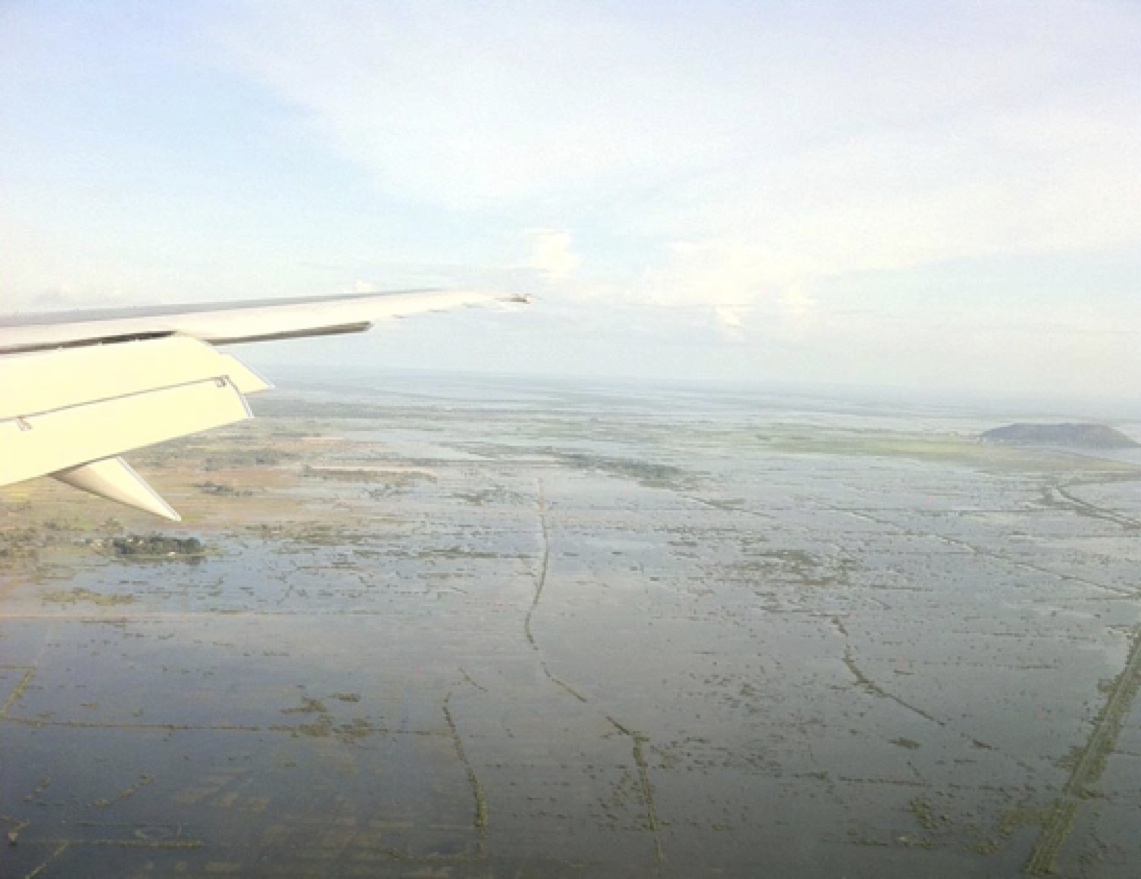
Late in the afternoon, we descended into Siem Reap, the gateway to Angkor. Out the window of the plane, you could see the vast lake of Tonlé Sap

2-TONLE SAP

Water defines the Angkor region, with some scholars arguing that the great empires here—with wealth enough to build the mammoth Angkor complex—are a result of the need for centralized planning and control of water resources, which, while abundant, can range from flood to draught throughout the year.
DAY 11, SAT., NOV. 9

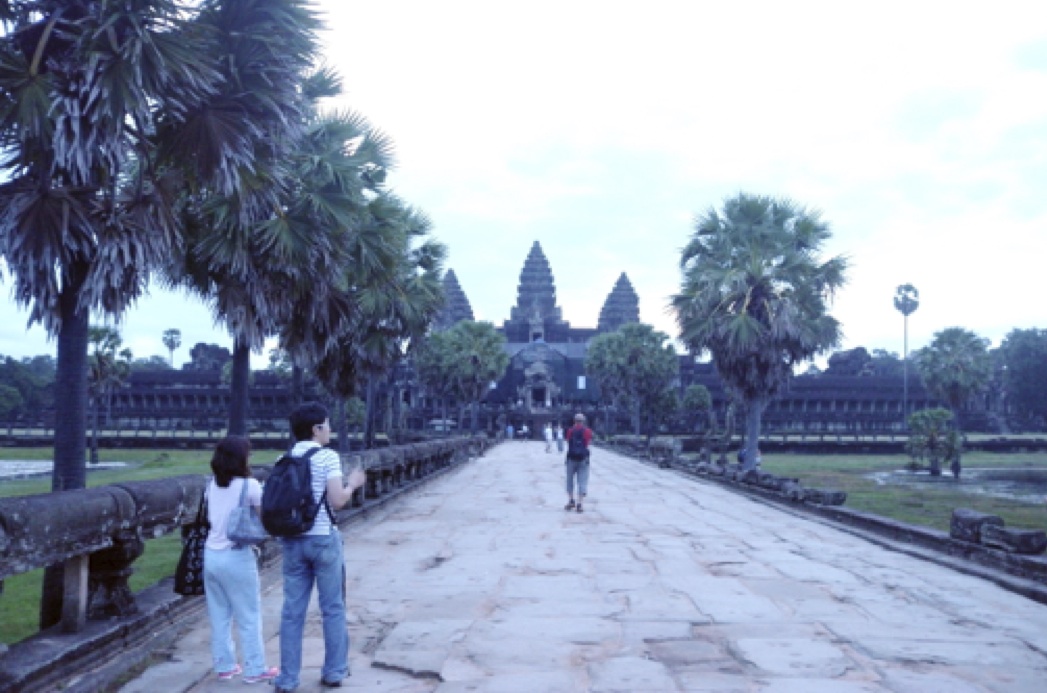
This morning, we were up and out at 5:15 to witness the sunrise, along with hundreds of other people, at Angkor Wat. Approaching the temple via the Naga (serpent) causeway I caught this picture at a moment when the crowds seemed to thin.

3-ANGKOR WAT

And this one of the temple reflected in its moat:

4-ANKGOR WAT

There really wasn’t much sunrise, but the morning was fascinating: Dara

5-DARA

guided us through a complete tour of the temple compound, including many of the galleries on which I had just lectured.

Here’s a large gallery on the northwest side with bas-reliefs from the Ramayana epic

6-GALLERY

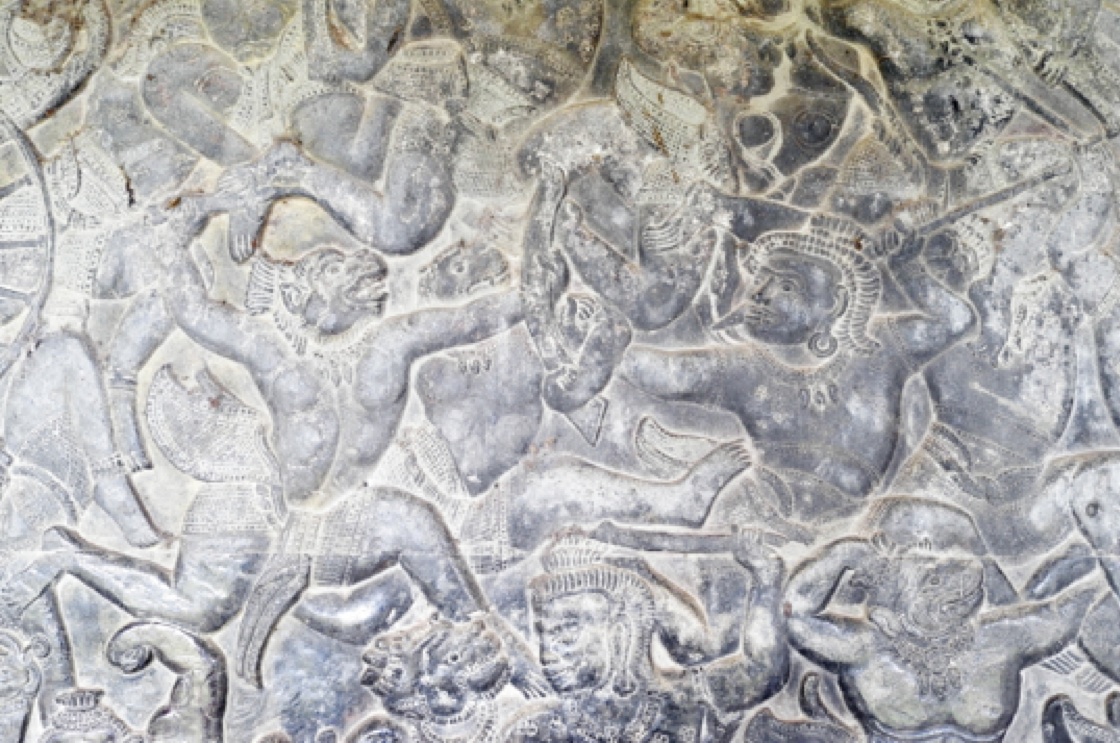
The quality of this carving is impressive. This is a panel dealing with the victory of Rama’s monkey ally, Hanuman, over one of the men of the demon Ravana:

7-HANUMAN

Everywhere through the temple, there are apsaras, celestial dancers. There are said to be 1,500 in all, many with distinctive hairstyles.

8-ASPARAS 1

9-ASPARAS 2

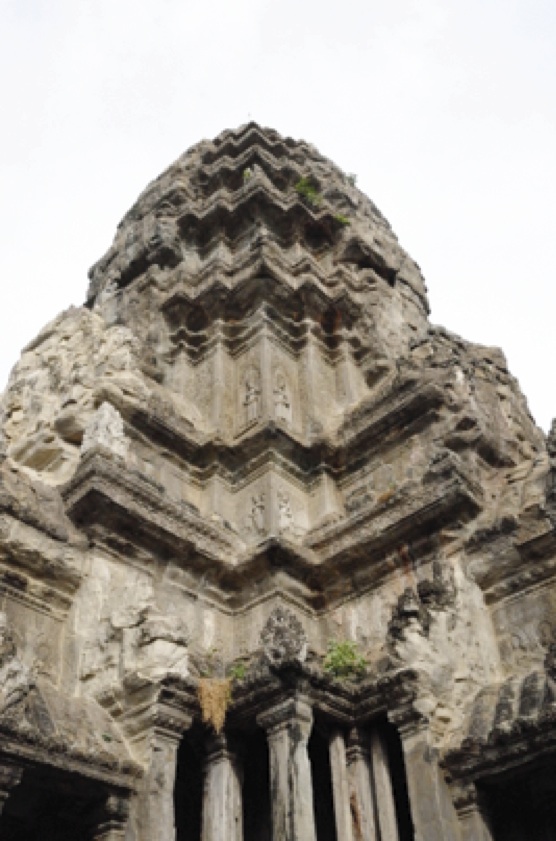
We climbed to the highest level, just beneath the central tower (representing Mt. Meru, the axis mundi)

10-STAIRS

11-MT. MERU

and then re-descended to walk the large southern and eastern galleries. The key bas-relief, on which I had just lectured, is the vast depiction of the gods and demons using the serpent Vasuki to churn the milky ocean in order to recover the elixir of immortality. You can see the serpent stretching out across the gallery.

12-CHURNING

And here at the center, an apsara over his head, is Vishnu standing on his turtle avatar, directing this cosmogonic/cosmological event.

13-CHURNING 2

This bas relief is crucial to the meaning of Angkor Wat, which, as a mausoleum for King Suryavarman II, represents his effort to ally himself with Vishnu’s role as the sustainer of the ordered universe.

Late in the morning, as the sun turned Angkor into a steam bath, we returned to our hotel, the exquisite Raffles (the best hotel so far, I think, on a trip of great hotels), and I was able to cool off in the hotel’s immense pool.

14-POOL

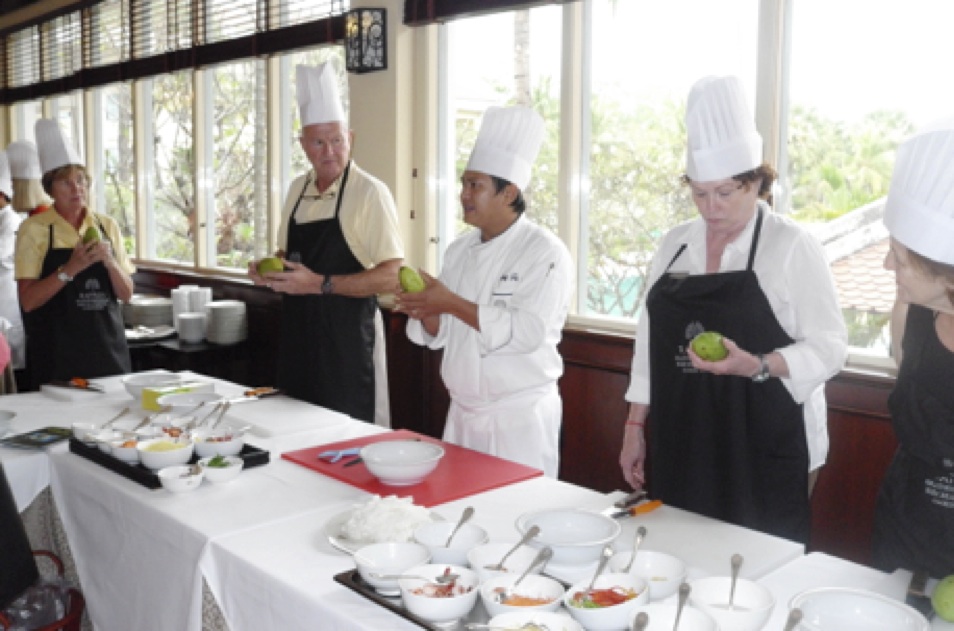
The afternoon was devoted to a special event: a cooking course offered by Raffles’ culinary department. This is the second such course I’ve taken (the first, a full day course, was a birthday present to me from Mary Jean some years ago when we were staying at the Oriental Hotel in Bangkok. I still treasure my gilded, framed certificate from that, which hangs on the wall of our Norwich kitchen.)

Although brief, only 2 ½ hours, this course rivaled the Oriental’s. After an introduction from the head chef, an Aussie, I think, we were divided into two groups and led by two Cambodian sous chefs.

15-COOKING 1

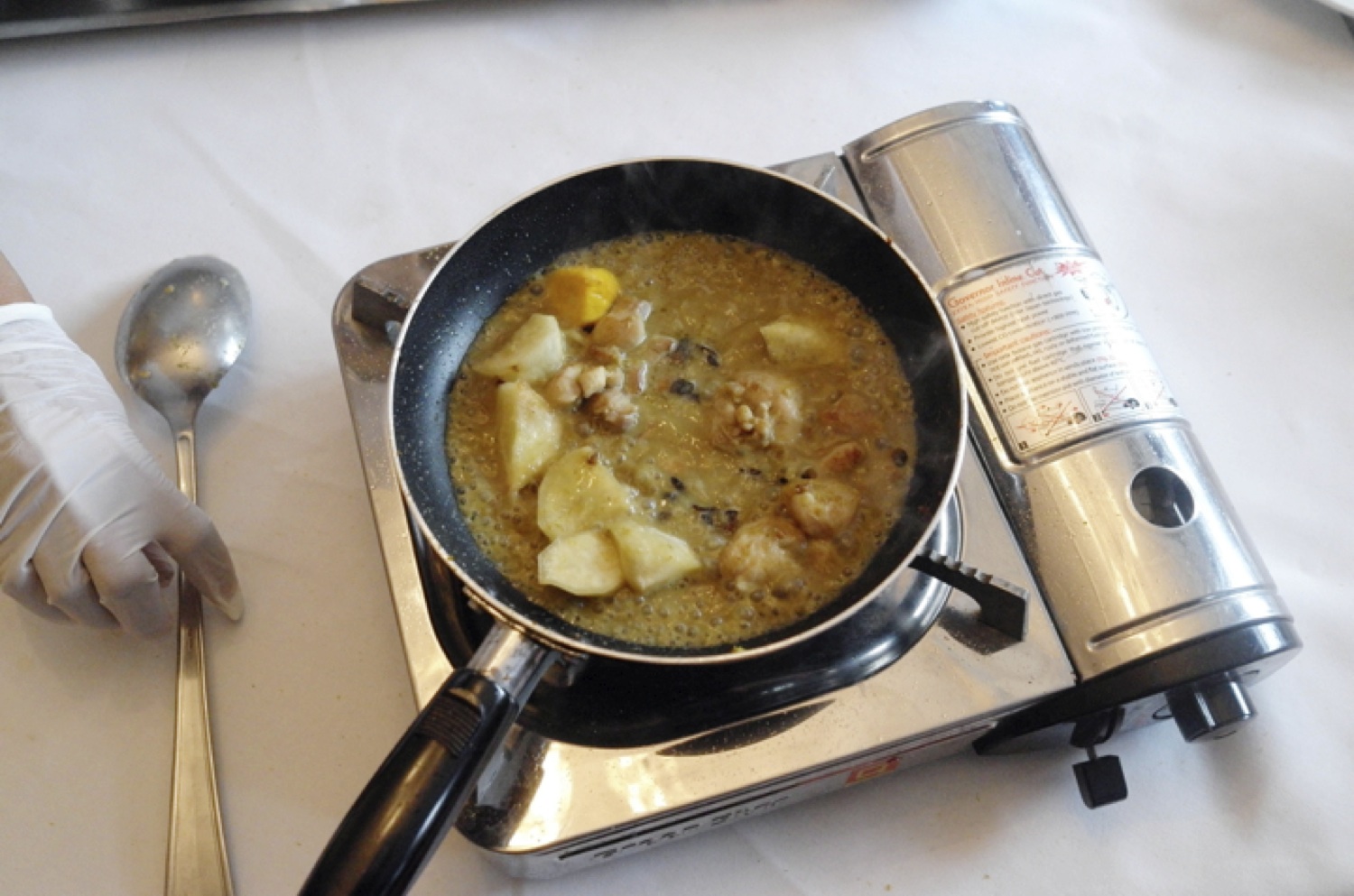
In all, we prepared five courses: a green mango salad (see above for the start; a very good salad), a sweet and sour tamarind flavored soup, spicy chicken in a coconut milk curry,

16-COOKING 2

a stir fried Chinese-style beef dish, and stir fried Cambodian kale (almost a cross between bok choy and broccolini). Here I am looking silly in my toque:

 17-RON

The finale of the course was special: a coconut-milk-custard-filled pumpkin. We didn’t do it ourselves, but watched one of the chefs, a cheerful woman, go through  the steps (the last of which is steaming the custard filled pumpkin for an hour).

18-PUMPKIN

19-PUMPKIN 2

20-PUMPKIN 3

Once I find just the right pumpkin, I’m going to try this at home for Thanksgiving. It tastes as good as it looks.

Standard
Travel

DAY 12, SUN., NOV. 10 ANGOR MORNING

This morning we visited two sites constructed by the last great Khmer monarch, Jayavarman VII (1125-1218 c. e.), the Ta Prom and the Bayon. Jayavarman departed from the Shaivite faith of his predecessors and adopted Buddhism, so both sites resonate with Buddhist iconography (although a Hindu reaction after his death led to the destruction or effacement of many sculptures and carvings). Ta Prom is a monastery dedicated to Jayavarman’s mother. The name (a later adoption) combines words for “grandmother” and “Brahma” in reference to the four-faced stupas (reliquaries) that dot the compound. Here is the small causeway that leads to the site:

1-ANGKOR THOM

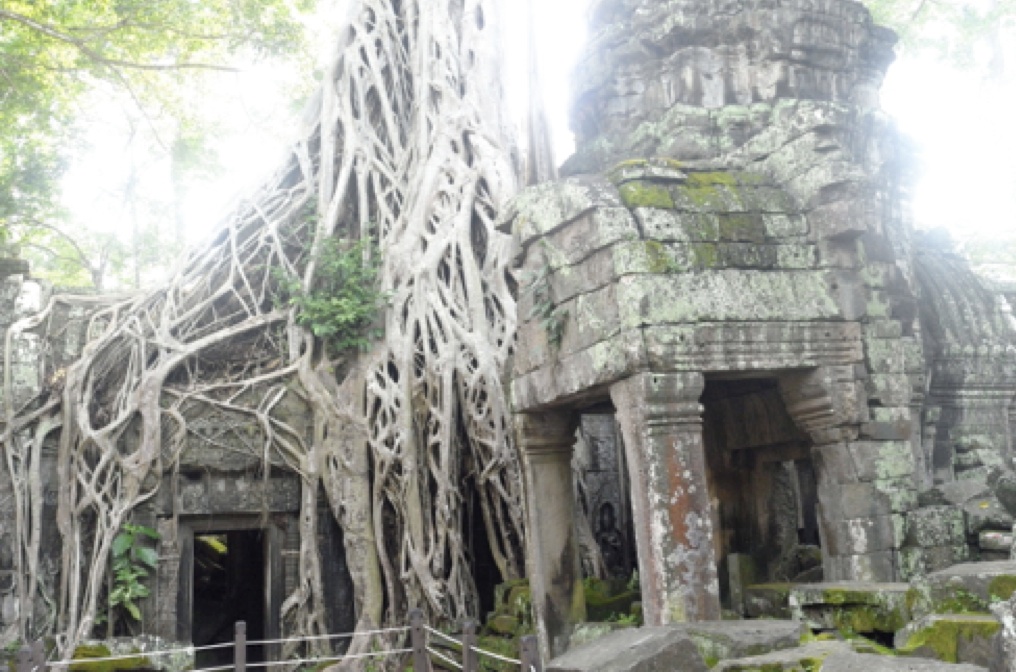
Ta Prom’s special charm comes from the many large trees that have spring up from roofs and the scattered stones, lending the site a romantic and haunting air. Apparently, “Tomb Raiders” with Angelina Jolie was filmed here. Our guide, Sam, took pleasure in pointing out specific places where scenes were shot.

2-ANGKOR THOM

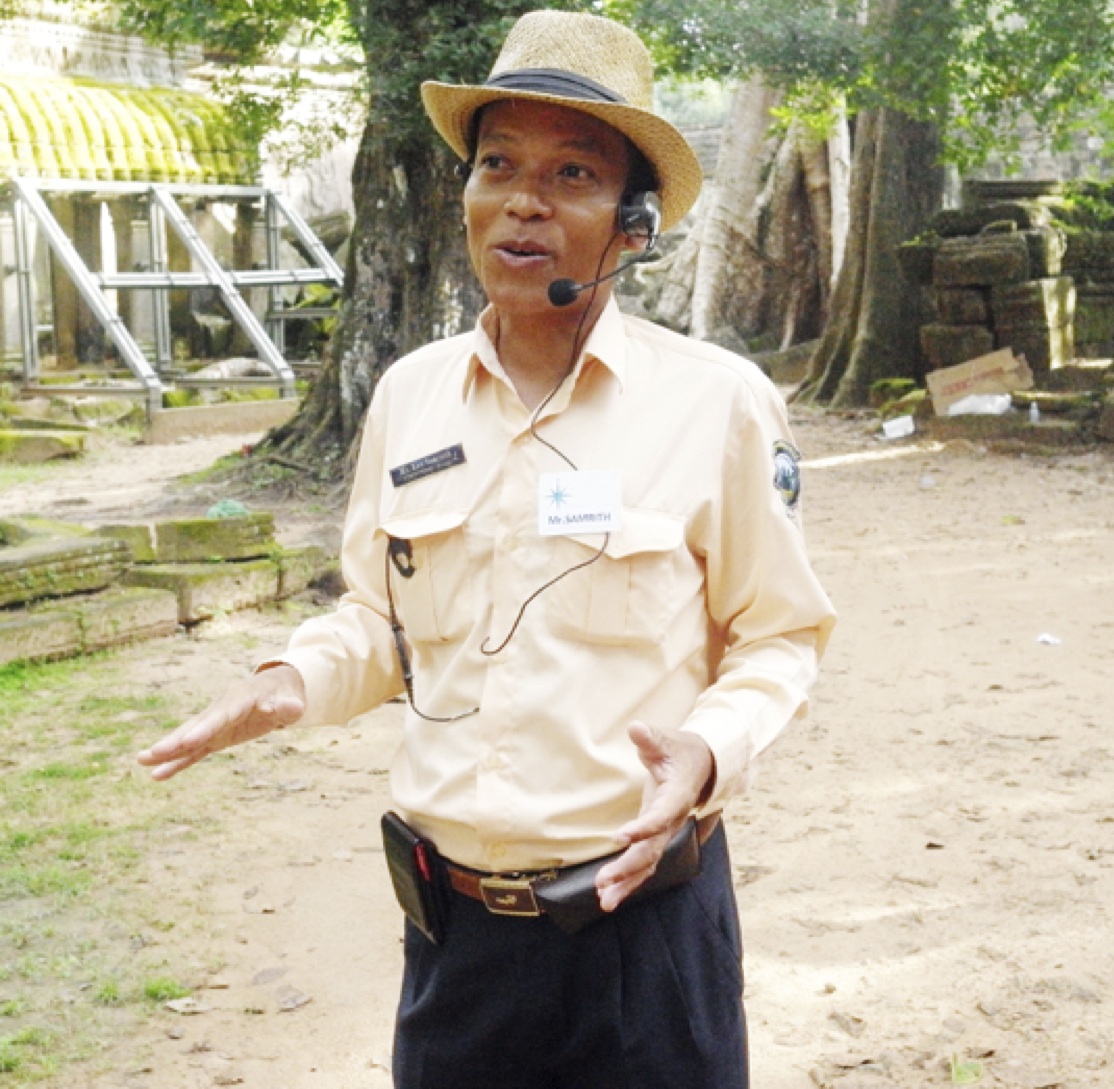
Sam is a story unto himself.

3-SAM

During our rides from site to site he told us about his life. As a sixteen-year old high school student in 1975, he and his entire family were ordered by the Khmer Rouge (Cambodian communists) out of Siem Reap to their natal village seventy kilometers into the countryside. Because the family was judged to be “middle class,” his father and older bother were soon shot. Although all high school students 10th grade and above were slated for liquidation, Sam, a tenth grader, somehow survived. He spent much of the next three and a half years of Khmer Rouge rule working in rice and cane fields. Workers had two scant meals a day. At one point, he was so hungry that he ate a fruit known to be toxic, a decision he survived with a bad headache and “fuller stomach.” A single mistake in handling the crops could lead to a visit by several “friendly” people from the regime. That would be the end. One of his friends accidentally cut down a small cane plant while removing weeds, and was so visited. The visitors said that they needed him for help on a project elsewhere but that he shouldn’t take his things because “he would be back that night.” The friend was never seen again. Many of the two million Cambodians who died (out of a population of eight million) disappeared in this way: a plant being worth more than a human being. At one point, in order to avoid being conspicuous as a student, Sam dyed his white school shirt black using the leaves of a toxic tree (he pointed these leaves out to us floating in the moat at Ta Prom). The ploy must have worked, although the toxin made Sam’s back itch whenever he he sweated heavily.

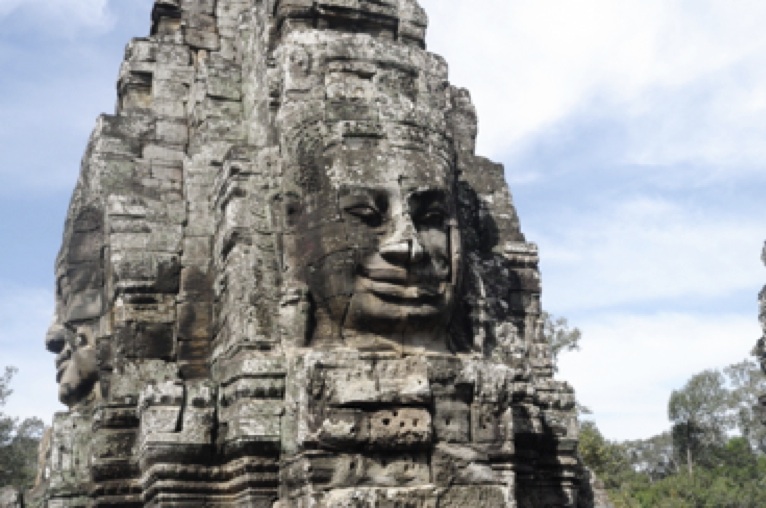
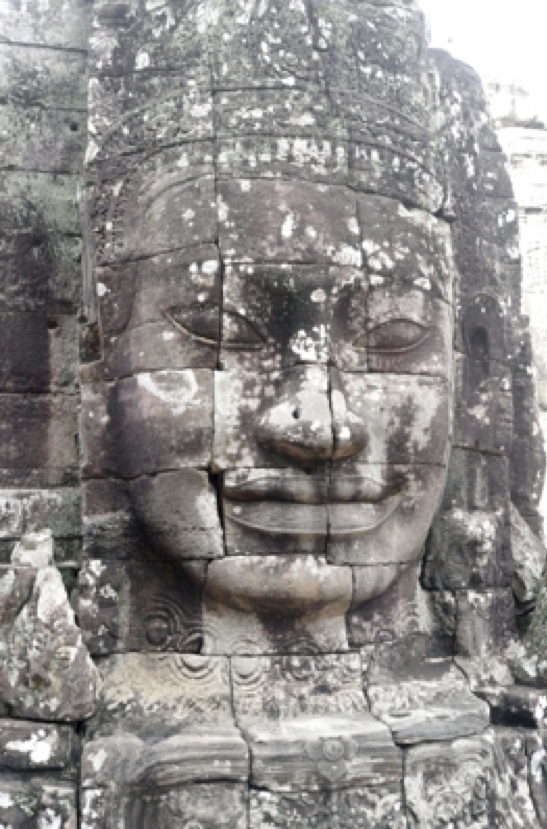
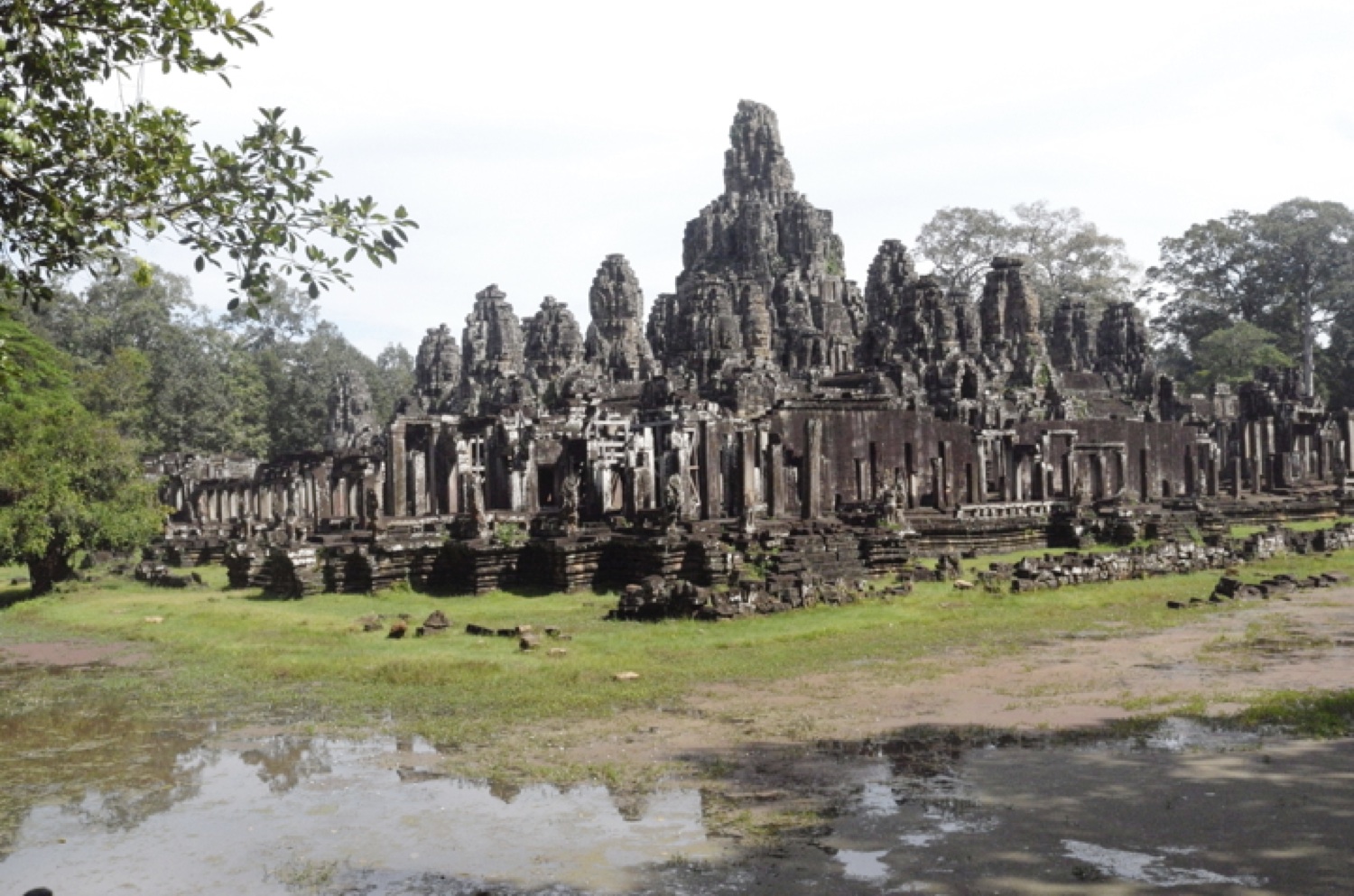
Our next stop was Angkor Thom and the Bayon, Jayavarman’s amazing tomb complex with dozens of four faced reliquaries, including a central one dedicated to the king himself. Researchers believe that many of these faces are of deceased members of Jayavarman’s retinue (120 name inscriptions have been found), although they also resemble the bodhisattva Avalokiteshvara. Once again, as I said in my lecture, we see a royal mausoleum that honors the dead king while linking him back to sacred events, in this case a Buddha-to-be and evocations of the four-faced creator God Brahma.

Here is the Bayon from the front:

4-BAYON

And here are two of the reliquaries, with their four-faced ancestors and/or images of the bodhisattva Avalokiteshvara:

5-FACE 1

6-FACE 2

Our visit ended with an elephant ride around the whole site. Here, some fellow travelers wobbling ahead of us on their elephant.

7-ELEPHANT

Finally, a parting image of the Bayon:

8-BAYON

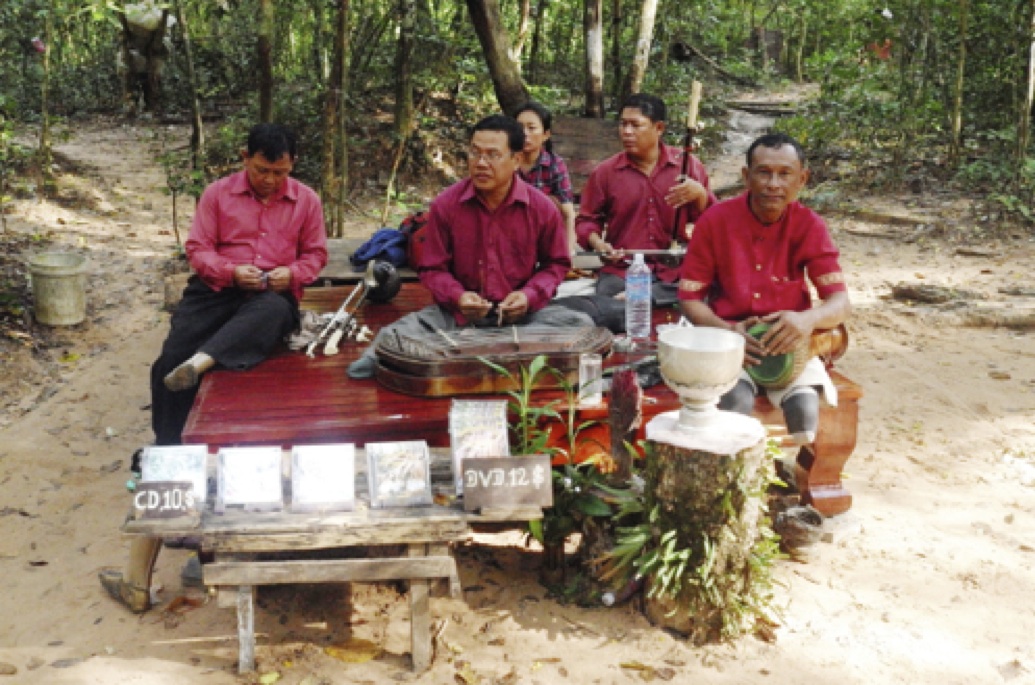
On the way back to the hotel, Sam told us of his years as a fighter on the Vietnamese side against the Khmer Rouge during Cambodia’s civil war, which lasted from 1979 until 1998. He also served during this period as a schoolteacher and school principal. Going to work, he carried an AK47 and took out some revenge on Khmer Rouge opponents for the murder of his father and brother. He was also very careful to keep an eye out for the Khmer Rouge landmines, small green plastic devices only big enough to blow one’s foot off, which Khmer Rouge insurgents routinely uses to protect themselves from pursuit. Here is a small musical band made up of landmine victims that set up shop on the pathway out of the Bayon.

9-MUSICIANS

By the way, Sam married a schoolmate with whom he worked during the Khmer Rouge years. He now has four children and six grandchildren. He’s a survivor.

Standard
Travel

DAY 12, SUN., NOV. 10 AFTERNOON

The afternoon was devoted to a visit to the Chong Kneas Floating Village on Tonlé Sap lake. This is one of a set of such villages that ring the lake, which expands from about 1,500 square miles in the dry season (November to April) to 4,500 square miles in the wet season (May to October), when the lake floods with waters that the Mekong River brings down from the snow melt in Tibet. According to our guide for the afternoon, Tek, about one million people live on the lake, most in houses that float on pontoons so that they can be moved to wherever the water is throughout the year. Many of the villagers are Vietnamese who came up the river from the Mekong Delta long before the Vietnamese war and who fled (or perished) during the Pol Pot regime and returned again after the regime’s demise in 1979. Here are the tour boats at the departure point, and one en route.

1-CHONG KNEAS 1

2-BOAT

As we were racing along, a small boat with a family pulled up next to us, and one of the young sons grabbed his way onto our boat in order to sell us soft drinks or water. Here he is on our boat, and here he is returning to his own. This lad should emigrate and start a career as a Somalian pirate.

3-BOY

4-BOY

Some scenes as we traveled through one of the Vietnamese villages. Homes:

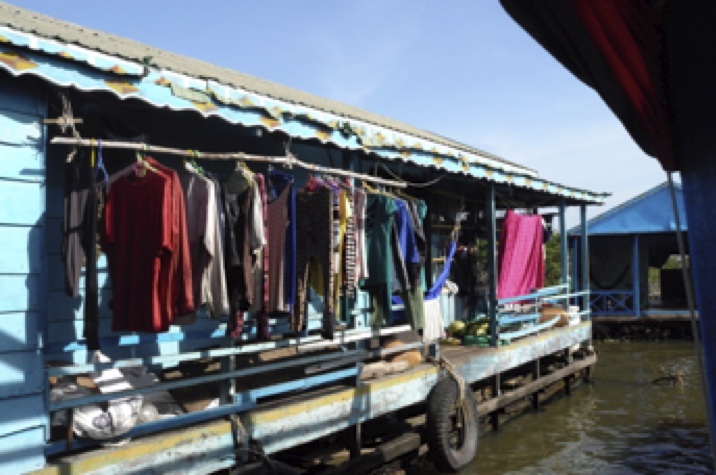
5-HOUSE

6-HOUSE

7-HOUSE

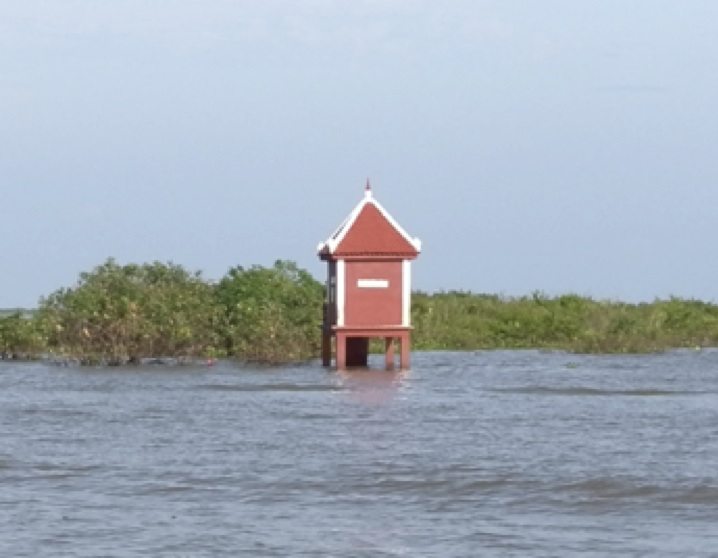
Here’s a “spirit house” put up by the cooperative of local fishermen (fishing is the major industry here) where offerings are made to ensure good catches:

8-SPIRIT HOUSE

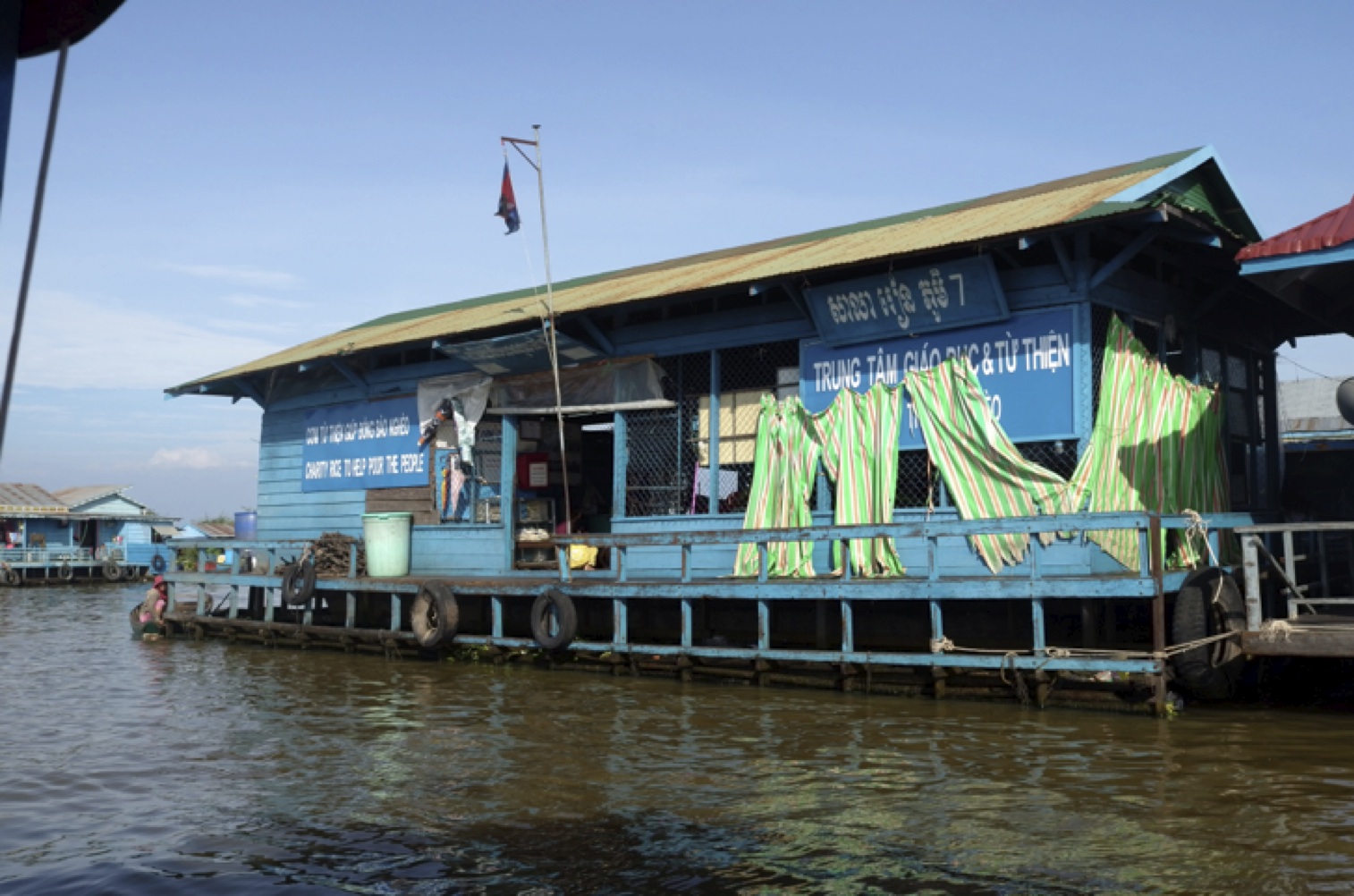
A communal help center. Shades of Pol Pot, the sign on the side reads “Charity Rice to Help Poor the People.”

9-CHARITY

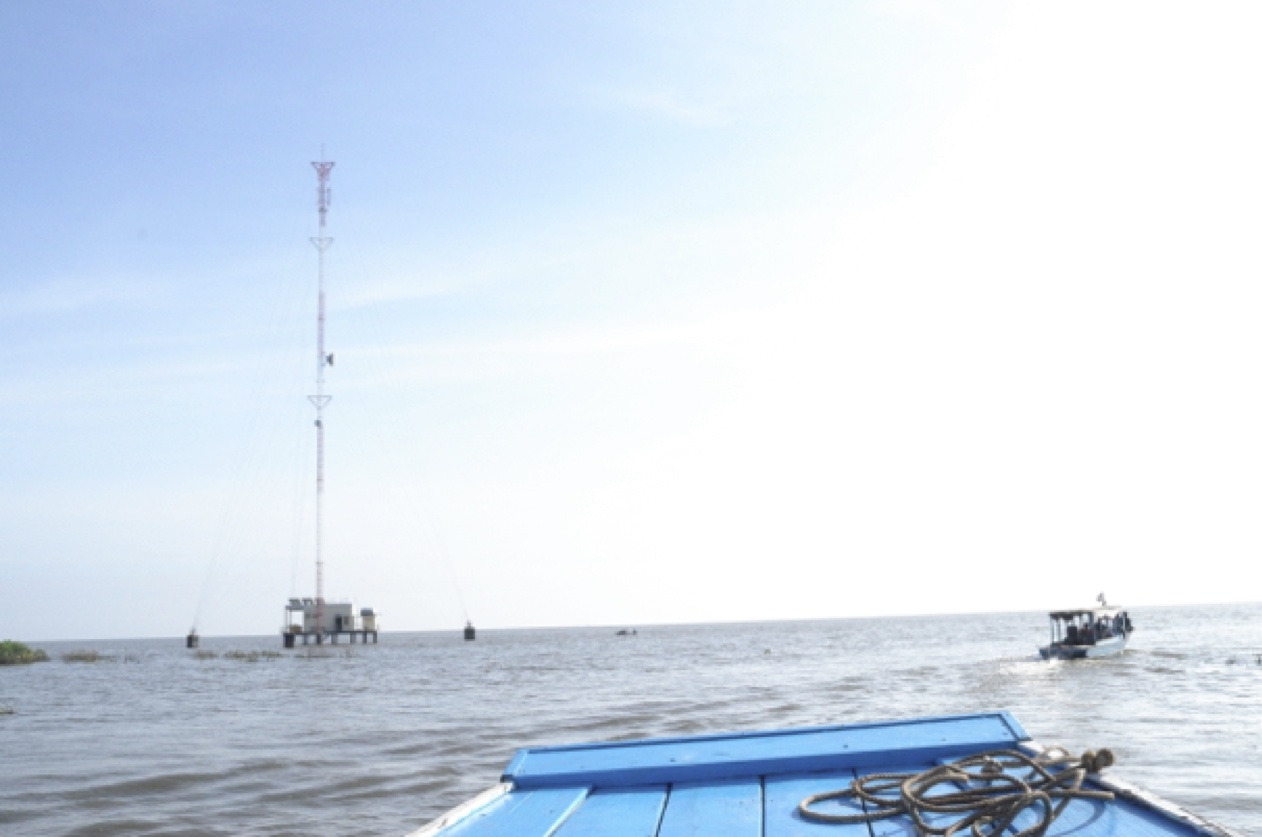
And here is the entry to the lake proper. The cell phone tower is newly built. Beyond it you can see the vast lake, whose far shore (now at its time of near maximum extent) is too distant to see.

10-TOWER

We traveled through another village. Here, a “big boat” restaurant.

11-BIG BOAT

A primary school.

12-SCHOOL

And a Catholic church and school.

13-CHURCH

On the way back, another pirate youngster tried to earn cash by showing off his snake for photographs. I gave him a 500 Riel note (about 12 cents) and he and his enablers grudgingly sailed off.

14-BOY WITH SNAKE

On the way back to our hotel in the bus, in response to questions, our guide Tek

 15-TEK

unfolded yet another horror story of the Pol Pot/Khmer Rouge years.

He was thirteen when the regime began. A city dwelling high school student, he and his family were sent to the countryside. His older brother was imprisoned because he had some education. During three months in prison, the brother was fed almost nothing (prisoners tried to survive by catching and eating insects that flew into their cells). Finally one of Tek’s sisters managed to “talk” the warden into releasing the brother. But he was so weakened by starvation that he died shortly after returning to the family.

Food in their village was cooked in communal kitchen. Each day’s meal was a thin gruel of rice. Many people died of hunger. Private cooking was forbidden (as was smoking in the village, because it could indicate a cooking fire using stolen rice from the communal fields).

During the dry season, when rice was scarce, to thin the excess population, people were routinely murdered. Tek survived by managing to get a job cutting wood in a distant forest during three dry seasons. The forest, which was terrifying to him at first, became his “friend,” as he lived alongside boa constrictors, boars, and other wild creatures.

Eventually, Tek saw that married men had a better chance of staying in the village and not getting killed than single men. So he and his wife married, along with nine other couples in a ceremony conducted by their “group leader.” When the regime was overthrown in 1979, many of the couples went their separate ways. Tek, a city dweller, offered his wife, a country person, the chance to return to her village with one of their two daughters, but she said, “You are my husband, I’ll stay with you.” They have since had four other children, all boys. Tek is another survivor of one of the grimmest periods in recorded history.

Our day ended with cocktails and a festive dinner on the Apsara Terrace of our hotel. A striking troupe of Cambodian dancers (male and female and dressed much like Thai dancers with large, spiked golden helmets) entertained us. No pictures since I left the camera in my room.

Standard